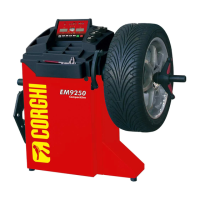
Operator’s manual @ 601 59
GB
sample weight and an average-size wheel. Perform the sensitivity calibration procedure
if necessary.
USE OF GREASE
Greasing the wheel balancer
The rotating parts of the wheel balancers are the motor and the balancing shaft. The bearing
of those components must therefore be checked periodically by the operator and greased
when necessary. If the machine is used frequently (more than two hours a day), check the
bearing every year; if the machine is not used frequently, the check can be performed
every two years. The bearing can be opened for inspection: insert a screwdriver and check
the subsequent sound to test it. The bearing acts as a locking support, therefore the
grease cannot be easily changed or removed. In addition, the rotation speed is not high
for the machine, so the grease does not need to be changed. If you see that operation
is anomalous or that the bearing is noisy, replace the bearing. If the customer confirms
the bearing has been replaced, replace only the grease, then remove the bearing, open
the dust sealing ring, and add grease (XHP103). These operations must be performed
under the guidance of a professional. After replacing the bearing calibrate the machine.
If the operation was performed correctly, the machine accuracy will be altered, therefore
reposition the dust sealing ring, re-assemble the machine and adjust again.
Technical safety sheet for using grease in the wheel balancer
Mobilgrease XHP 103
NLGI Grade
3
Thickener Type Li-complex
Colour Dark blue
Penetration in manufactured material 25ºC , ASTM D 217,
mm/10
235
Dropping Point, ºC , ASTM D 2265
280
Basic oil viscosity, ASTM D 445, cSt @ 40ºC
100
Penetration consistency change, ASMT D 1831 (grease mechanical
stability), mm/10
10
4 ball test, impression diam., ASTM D 2266, mm
0.5
4 ball test, weld load, ASTM D 2509, Kg
315
Timken OK load test, ASTM D 2509, lb
45
Oxidation stability, bomb method, ASTM D 942, pressure drop
after 100 hours, kPa
35
Corrosion Prevention, ASTM D 1743
Passed
Emcor Rust, IP 220, washout using acidic water
0
Rust Protection, IP 220-mod, washout using distilled water
0



 To Next Page