Transport and practical equipment
Trapdoor for transporting long ob-
jects*
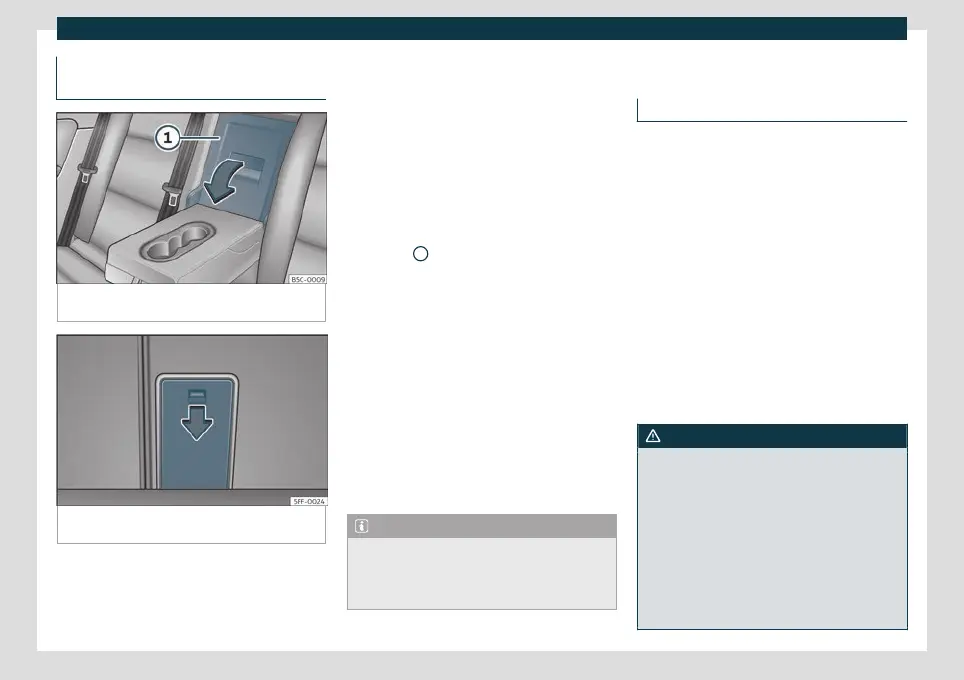
Fig. 119
In the rear seat backrest: opening the
trapdoor.
Fig. 120
In the luggage compartment: opening
the trapdoor.
On the rear seat, behind the central armrest,
ther
e is a t
ailboard for transporting long
items in the interior, such as skis.
To avoid soiling the interior, dirty objects
should be wrapped (e.g. in a blanket) before
they are inserted through the tailboard.
When the armrest is down, nobody may trav-
el in the centre rear seat.
Opening the tailboard
●
Lower the centre armrest.
●
Pull the release lever in the direction of the
arrow and push the tailboard cover
›››
Fig. 119
1
down and forwards.
●
Open the rear lid.
●
Insert the long objects through the gap
fr
om the lugg
age compartment.
●
Secure the objects with the seat belt.
●
Close the rear lid.
Closing the tailboard
●
Lift the tailboard cover until it engages. The
red mark on the luggage compartment side
should never be visible.
●
Close the rear lid.
●
Lift the centre armrest if necessary.
Note
The tailboard can also be opened from the
luggage compartment. To do so, press the
release lever down, in the direction of the
arrow, and the cover upwards
›››
Fig. 120 .
Roof carrier
Introduction
The vehicle roof has been designed to opti-
mise aerodynamics. F
or this reason, cross
bars or conventional roof carrier systems
cannot be secured to the roof water drains.
As the roof water drains are integrated in the
roof to reduce air resistance, only CUPRA-
approved cross bars and roof carrier systems
can be used.
Cases in which cross bars and the roof car-
rier system should be disassembled.
●
When they are not used.
●
When the vehicle is washed in a car wash.
●
When the vehicle height exceeds the max-
imum height, for e
xample, in some garages.
WARNING
●
Always secure the load properly using
belts or retaining straps that are suitable
and in a good condition.
●
Bulky, heavy, long or flat loads have a
negative effect on aerodynamics, the cen-
tre of gravity and driving performance.
●
Avoid sudden braking and manoeuvres.
●
Adapt your speed and driving style at all
times to suit visibility, weather, road and
traffic conditions.
»
139



 To Next Page
 Loading...