Need help?
Do you have a question about the D-Link DSL-X3052E and is the answer not in the manual?
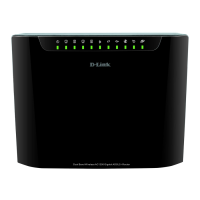
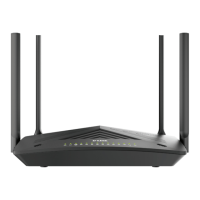
The D-Link AX3000 Wi-Fi 6 VDSL2/ADSL2+ Modem Router with VoIP (DSL-X3052E) is an integrated access device designed for smart home connectivity. It leverages the latest DSL technology to support combined voice, video, and data services through existing network infrastructure. The router augments your home or office with Wi-Fi 6 wireless LAN and Internet telephony using IP transport connectivity, aiming to save costs and offer convenience without compromising call quality or functionality.
The DSL-X3052E serves as both a modem and a router, supporting VDSL2 and ADSL2+ broadband connections. It features Wi-Fi 6 (802.11ax) for high-speed wireless connectivity, offering a data rate of up to 3000 Mbps and lower latency compared to previous wireless protocols. Key Wi-Fi 6 improvements include Orthogonal Frequency Division Multiple Access (OFDMA), Overlapping Basic Service Sets (OBSS), beamforming, and Target Wake Time (TWT) for efficient power management. The device also includes VoIP capabilities for reliable phone services over the Internet. It has a USB port for file sharing and can support a 4G USB adapter for backup Internet connectivity.
The router supports various WAN connection types including ADSL, VDSL, and Ethernet. It can function as both a modem and a router, or as a router only, connecting to existing cable/NBN™/UFB modems. The setup wizard guides users through initial configuration, including detecting connection types (Dynamic IP, Static IP, PPPoE, Bridge Mode) and setting up Wi-Fi networks.
The DSL-X3052E provides dual-band Wi-Fi (2.4 GHz and 5 GHz) with Wi-Fi 6 technology. Users can configure separate SSIDs and passwords for each band. Advanced wireless settings include hiding SSID, WMM QoS, signal interval, DTIM, transmitting power, fragmentation threshold, 802.11 mode selection, TWT button for power saving, and channel width. Guest Zone functionality allows creating separate networks for guests, isolating them from the local network. WPS (Wi-Fi Protected Setup) is available for easy connection of wireless clients.
The USB 3.0 port allows for storing and sharing files within the local network using Samba file sharing protocol. It supports FAT32 or NTFS-formatted USB storage devices. DLNA media server functions can be enabled for connected DLNA clients to access media files. Additionally, the USB port supports 3G/4G mobile broadband adapters as a backup for the primary Internet connection.
The router supports Voice over IP (VoIP) with two FXS phone ports. Users can configure VoIP providers, including protocol (SIP), binding interface, and region. Main and secondary configuration settings for registrar servers, proxy servers, and outbound proxies are available. Line configuration allows enabling/disabling phone ports, setting account details, and configuring audio codecs (G.722, G.711 a-law, G.711 u-law, G.729, G.723) and packetization time. Advanced VoIP settings include registration expire timer, register retry interval, DTMF relay mode, telephone event payload type, session timer, minimum session timer, session refresher rule, and session update method. SIP Filter allows configuring rules to blacklist or whitelist incoming calls based on SIP addresses.
Allows upgrading the router's firmware by uploading a relevant file from D-Link's support website.
The router keeps a running log of events. System logging can be enabled, and log entries can be saved to a local hard drive or sent to a syslog server. Log levels can be configured (Emergency, Alarm, Important, Error, Warning, Notice, Debug).
Configures the internal system clock, including automatic synchronization with NTP servers and time zone selection. Allows creating schedules for various functions, such as wireless network availability.
Provides tools to test the router's connection to other devices on the Internet, including Ping Test and Traceroute Test, to verify availability and trace data routes.
The device is an Energy Related Product (ErP) with High Network Availability (HiNA). It automatically switches to a power-saving Network Standby mode within 1 minute of no packet transmission. It can also be manually turned off via a power switch.
 General
| Brand | D-Link |
|---|---|
| Model | DSL-X3052E |
| Category | Wireless Router |
| Language | English |

 To Next Page