S0309000
Page 9
Standard Torques
Return to Master Table of Contents
TORQUE WRENCH EXTENSION TOOLS
Very large diameter, high grade fasteners (nuts, bolts, cap screws, etc.) require a great deal of turning force
in order to achieve recommended tightening torque values.
Common problems that could occur as a result are:
• Recommended torque exceeds the measuring capacity of the torque wrench.
• Specialized sockets do not fit the adapter on the front end (nose) of the torque wrench.
• Generating adequate force on the back end (handle) of the wrench is difficult or impossible.
• Restricted access or an obstruction may make use of the torque wrench impossible.
• A unique application requires fabrication of an adapter or other special extension.
Most standard torque wrenches can be ad apted to s uit any one of the p roceeding needs or situations, if
the right extension tool is used or fabricated.
TORQUE MULTIPLICATION
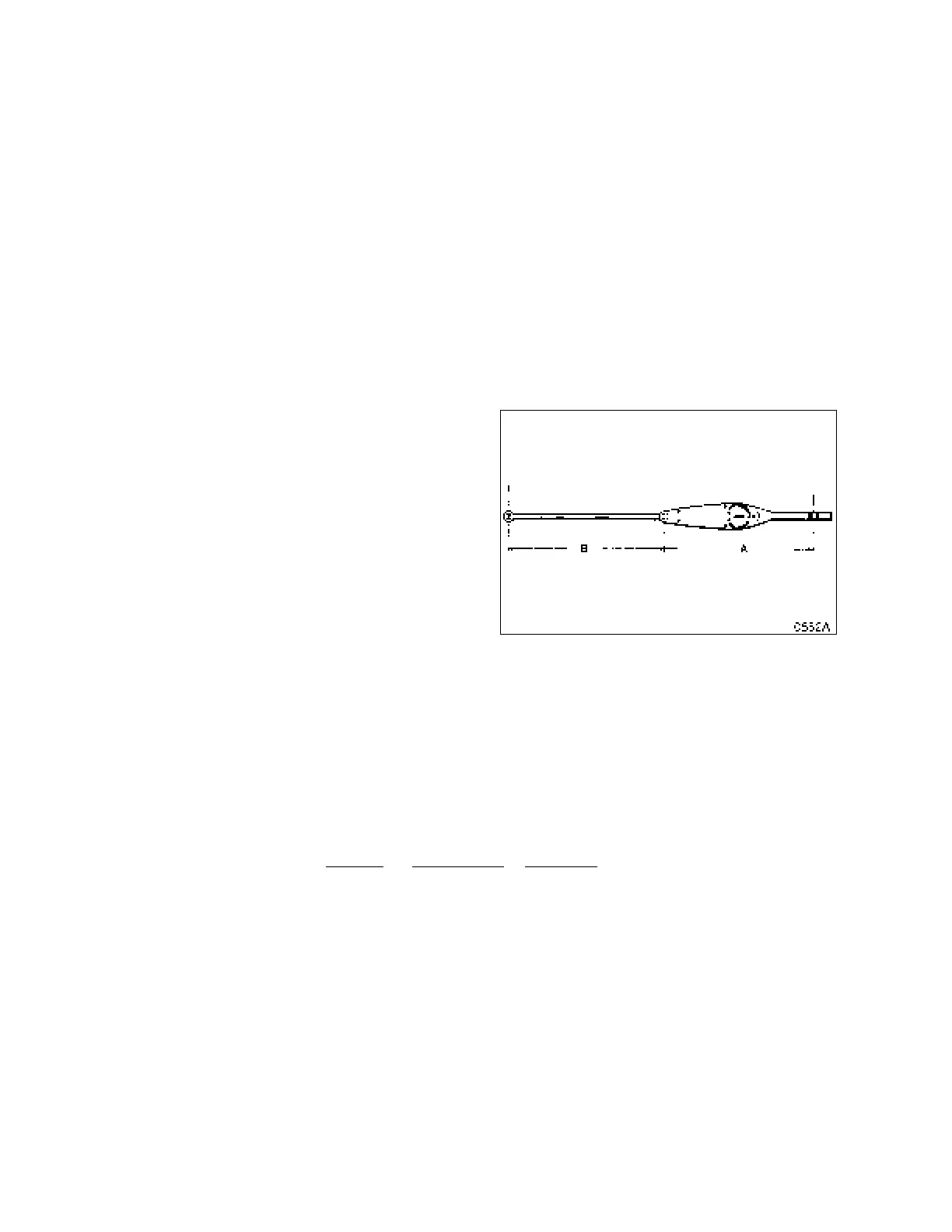
A wr ench extension tool ca n be us ed to
increase the tightening force on a hi gh capacity
nut or bolt.
For example, doubling the distance between the
bolt and the bac k (handle) end of the tor que
wrench doubles the tightening force on the bolt.
It also halves the indicated reading on the scale
or dial of the to rque wr ench. T o accurately
adjust or convert indicated sc ale o r di al
readings, use the following formula:
I = A x T / A + B where:
I = Indicated force shown on the torque wrench
scale or dial.
T = Tightening force applied to the nut or bolt (actual Torque).
A = Length of the torque wrench (between the center of the nut or bolt and the center of the handle).
B = Length of the extension.
As an e xample, if a 12" extension is added to a 12" torque wrench, and the indicated torque on the dial
reads “150 ft lb,” the real force applied to the bolt is 300 ft lb:
NOTE:
The formula assumes that there is no ad ded deflection or “give” in the joint between the
extension and torque wrench. Readings may also be inaccurate:
• If the extension itself absorbs some of the tightening force and starts to bend or bow out.
• If an extension has to be fabricated that is not perfectly straight (for example, an extension made
to go around an obstruction, to allow access to a difficult to tighten fastener), the materials and
methods used must be solid enough to transmit full tightening torque.
I =
A x T
=
12 x 300
=
3600
=150
A + B 12 + 12 24
Figure 1



 To Next Page