
 Need help?
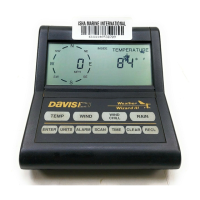
Do you have a question about the DAVIS Weather Wizard III and is the answer not in the manual?
Lists tools and materials required for installing the Weather Wizard III.
Explains how to power the Weather Wizard III using AC adapter and battery backup.
Details how to connect the console to the junction box using the provided cable.
Procedures for testing the wind speed and direction sensors.
Steps to test the external temperature sensor for correct readings.
Detailed instructions for mounting the anemometer on various surfaces.
Guidelines for positioning and installing the external temperature sensor.
Explains the function and usage of the ENTER key for data input.
How the Weather Wizard III measures and displays temperature.
Explains how wind speed and direction are displayed and measured.
Explains wind chill calculation and display.
Information on using the rainfall function with the optional Rain Collector.
Explains the alarm system, conditions, and display.
Describes how high and low alarms are triggered and behave.
How alarms are indicated on the console display.
Instructions for programming new alarm set points.
Explains the function to reset all high/low readings and alarms.
How to use the automatic scanning feature of the console.
Step-by-step guide on how to change calibration numbers.
Addresses common console display problems like blank, flashing, or unresponsive screens.
Steps to resolve when the console display freezes or becomes unresponsive.
Contact information for customer support and service inquiries.
 General
| Wind Speed Range | 0 to 150 mph (0 to 241 km/h) |
|---|---|
| Data Logging | No |
| Display Type | LCD |
| Wind Direction Display | 16 points on compass rose |
| Wind Direction Range | 360° |
| Temperature Accuracy | +/- 2°F (+/- 1°C) |
| Battery Life | Approximately 1 year (console) |



 To Next Page