44
Glossary
teraction between two or more input frequen-
cies. IM distortion, like harmonic distortion, is
usually rated as a percentage of the total output
power of the device. While some types of har-
monic distortion are musical, and not particu-
larly objectionable, most IM distortion is
unpleasant to the ear. ·
Impulse Response
Related to the rise time of a circuit, the impulse
response is a measurement of the ability of a cir-
cuit to respond to sharp sounds, such as percus-
sion instruments or plucked strings. A circuit
with good impulse response would tend to
have good transient response.
Leveling
The process of taking a passage that varies in
loudness and using a compressor to even out
the sound. For instance, if a bass guitar has a
few notes that for some reason resonate louder
than others, the compressor will knock them
down a bit. If the ratio is set to infinity, it will
try to make all the notes exactly the same level,
as long as they are above threshold. Leveling re-
quires careful adjustment of the threshold and
compression ratio, and usually requires adjust-
ment of the output gain to compensate for over-
all level changes produced by the compression.
Level Match
The dbx noise reduction system is unlike com-
petitive systems in that there is no one thresh-
Glossary
Limiting
A specific type of compression where the pro-
gram output level of the audio signal is kept at
or below some absolute level (see Threshold).
Generally, limiting occurs with compression ra-
tios of 10:1 or greater .
Line Level (Line Input)
Line level refers to a preamplified audio signal,
in contrast to mic level, which describes a
lower-level audio signal. The actual signal lev-
els vary. Generally, mic level is nominally
-SOdBu (with typical dynamic range-64dBu to
+lOdBu). Line level signals vary, depending on
the audio system. Semi-pro line levels are nomi-
nally - lOdBu, whereas professional line levels
are nominally +4dBu or +8dBu (with typical dy-
namics ranging from -SOdBu to +24dBu).
Line inputs are simply input s that have sensitiv-
ities intended for line level (preamplified) sig-
nals. Often, the nominal impedance of a line
level input will be different than the nominal
impedance of a mic level input.
Modulation Noise
Modulation noise is a swishing type of back-
ground hiss that occurs with tape recordings in
the presence of strong low frequency signals.
The noise depends on the level of the recorded
signal; the higher the recorded signal level, the
higher the modulation noise. Modulation noise
old at which compression or expansion begins.
Instead, compression occurs linearly, with re-
spect to decibels, over the full dynamic range of
the program. By necessity, there is an arbitrary
signal level which passes through the encoder
and decoder without being changed in level.
This level is known as the level match point
(transient point). Some dbx equipment pro-
vides for user-adjustment of the level match
point, for monitoring purposes only. Although
this not necessary for proper encode/ decode
performance, by setting the level match point
to be approximately equal to the nominal (aver-
age) signal level, there will be no increase or de-
crease in level as you switch from monitoring
"live" program to monitoring dbx-processed
program.
Limiter
A limiter is a type of compressor, one with a in-
finity:1 or greater compression ratio. A limiter
with a high compression ratio (120:1) can be set
so that no amount of increase in the input sig-
nal will be able to raise the output level beyond
a preset value. The difference between limiting
and compression is that compression gently
"shrinks" dynamic range, whereas limiting is a
way to place a fixed "ceiling" on maximum
level, without changing the dynamic range of
program below that "ceiling" of threshold.
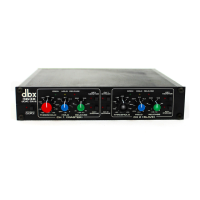
dbx 160XT
has typically been "masked," hidden by the
dominant signal and/ or by the background
hiss of the tape. However, when the back-
ground hiss is removed, as with dbx process-
ing, modulation noise could become audible.
This would happen primarily with strong, low
frequency signals, but in fact it is minimized by
dbx's pre-emphasis and de-emphasis. See As-
perity Noise.
Octave
In music or audio, an interval between two fre-
quencies having a ratio of 2:1; 20Hz, 40Hz,
80Hz are said to be octaves of each other.
Output Gain
Control for increasing or decreasing the pro-
gram level. In the 160XT, the gain control is lo-
cated after the compressor, so the output gain
does not affect the amount of compression or
the dynamic range. For example, when a fixed
amount of gain is added at the output of a com-
pressor, like the 160XT, the level of the loudest
passages can be restored, and the soft passages
will be brought up to a level greater than before
the compression.
Over Easy® Compression
dbx Over Easy compression permits extremely
smooth, almost inaudible compression due to
the gradual change of compression ratio
around the threshold, instead of the customary
sharp (Hard-Knee) threshold.
45


 To Next Page