46
Glossary
Overshoot
When a compressor or expander changes it~
gain in response to a fast increase or decrease in
level, the maximum gain change should be di-
rectly proportional to the actual signal level.
However, in some compressors the level detec-
tion and gain ch~nging circuitry develop a kind
of "inertia," over-reacting to changes in level,
increasing or decreasing the gain more than the
fixed ratio asked for. This over-reaction is
known as overshoot, and it can cause audibly
non-linear compression (distortion). dbx cir-
cuits have minimal overshoot, so they provide
highly linear compression and expansion.
Peak Level
An audio signal continuously varies in level
(strength, or maximum voltage) over any pe-
riod of time, but at any instant, the level may
be higher or lower than the average. The maxi-
mum instantaneous value reached by a signal
is its peak level (see RMS level).
Phase Inversion
"Phase inversion" refers to the swapping of po-
larity. This use of the term "phase," refers to the
polarity of the signal and differs from the defi-
nition of phase shift below .
Phase Shift
"Time shift" is another way to describe phase
shift. Some circuitry, such as record electronics
and heads, will delay some frequencies of an
Glossary
be a separate component, or part of an inte-
grated amplifier or receiver.
Pre-emphasis
(See De-emphasis)
Receiver
A single unit that combines tuner, preamp and
power amplifier sections.
Release Time or Release Rate
(See Decay Time and Attack Time)
Rise Time (Attack Time)
This is the ability of a circuit to follow (or
"track") a sudden increase in signa l level. The
shorter the rise time, the better the frequency re-
sponse. Rise time is usually specified as the in-
terval (in microseconds) required to respond to
the leading edge of a square-wave input.
RMS Level
RMS level (Root Mean Square) is a measure-
ment obtained by mathematically squaring all
the instantaneous voltages along the wave-
form, adding the squared values together, and
taking the square root of that number. For sim-
ple sine waves, the RMS value is approximately
0.7<J7 times the peak value, but for complex
audio signals, RMS value is more difficult to
calculate. RMS level is similar to average level,
although not identical (Average level is a
slower measurement).
audio program with respect to othe r portions
of the same program. In other words, phase
shift increases or decreases the delay time as
the frequency increases. On an absolute basis,
phase shift cannot be heard, but when two sig-
nals are compared to one another, one having a
phase shift_ relative to the other, the effects can
be very noticeable, and not very desirable. Ex-
cessive phase shift can give a tunnel-like qual-
ity to the sound. Phase shift also can degrade
the performance of compander type noise re-
duction systems which depend on peak or aver-
age level detection circuitry.
Power Amplifier
A unit that takes a medium-level signal (e.g.,
from a preamplifier) and amplifies it so it can
drive a loudspeaker. Power amplifiers can oper-
ate into very load impedance loads (4-16
ohms), whereas preamplifiers operate only into
low impedance (600 ohms) or high impedance
(5,000 ohms or higher loads). Also known as a
main amplifier, the power amplifier may be
built into an integrated amplifier or a receiver.
Preamplifier
A device which takes a small signal (e.g., from
a microphone, record player), or a medium-
level signal (e.g., from a tuner or tape recorder),
and amplifies it or routes it so it can drive a
power amplifier . Most preamplifiers incorpo-
rate tone and volum e controls. A preamp may
dbx 160XT
RMS Level Detector
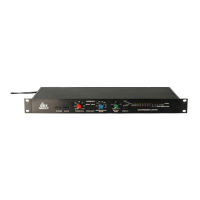
In the dbx 160XT, the RMS level detector senses
the power in the program in a musical manner,
much as the ear does, giving results superior to
peak or average detection.
Sub Harmonic
A sub-multip le of the fundamental frequency.
For example, a wave the frequency of which is
half the fundamental frequency of another
wave is called the second sub harmonic of that
wave.
Sub Woofer
A loudspeaker made specifically to reproduce
the lowest of audio frequencies, usua lly be-
tween 20Hz and lOOHz.
Synthesizer
An Electronic Music Synthesizer is an audio
processor that has a built-in sound generator
(oscillator) and that alters the envelope of the
sound with voltage controlled circuitry. Syn-
thesizers can produce familiar sounds and
serve as musical instruments, or they can create
many unique sounds and effects of their own.
A sub-harmonic Synthesizer is a device which
is not used to create music, but to enhance an
existing audio program. It creates a new signal
that corresponds to the input signal, but is ½
the frequency.
47


 To Next Page