2.2 95-871414
impoRtant SafEty notES
CAUTION
The wiring procedures in this manual are
intended to ensure proper functioning
of the system under normal conditions.
However, because of the many variations
in wiring codes and regulations, total
compliance to these ordinances cannot
be guaranteed. Be certain that all wiring
complies with the NEC as well as all
local ordinances. If in doubt, consult the
authority having jurisdiction before wiring
the system. Installation must be done by a
properly trained person.
CAUTION
This product has been tested and
approved for use in hazardous areas.
However, it must be properly installed
and used only under the conditions
specified within this manual and the
specic approval certicates. Any device
modication, improper installation, or use
in a faulty or incomplete conguration will
render warranty and product certications
invalid.
CAUTION
The system contains no user serviceable
internal components. Service or repair
should never be attempted by the user.
Device repair should be performed only
by the manufacturer or trained service
personnel.
LIABILITIES
The manufacturer’s warranty for this
product is void, and all liability for proper
function of the system is irrevocably
transferred to the owner or operator in
the event that printed circuit boards
are removed or the device is serviced
or repaired by personnel not employed
or authorized by Detector Electronics
Corporation, or if the system is used in a
manner not conforming to its intended use.
CAUTION
Observe precautions for handling
electrostatic sensitive devices.
NOTE
The LS2000 is intended for detection of
hydrocarbon vapors only. The device will
not detect hydrogen gas.
NOTE
The terminal compartment for LS2000
without relays is designed for either
an increased safety “e” termination or a
flameproof “d” termination of the supply
cable. If a flameproof connection is
chosen, then an ATEX certied cable entry
device must be used. The LS2000 with
relays requires Ex d cable entry devices
only.
inStallation
IDENTIFICATION OF VAPOR(S) TO BE
DETECTED
It is necessary to identify the flammable
vapor(s) of interest at the job site in order to
determine the proper calibration gas setting for
the LS2000. In addition, the physical and fire
hazard properties of the vapor, such as vapor
density and flashpoint should be identified and
used to assist in selecting the optimum detector
mounting locations within the area. The detector
must be installed by qualified personnel only,
following local electrical equipment installation
practices.
SYSTEM LOCATION CONSIDERATIONS
The LS2000 system is designed for installation
in hazardous industrial areas. Each module is
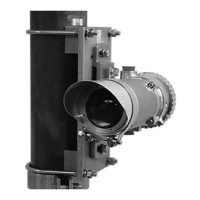
normally installed using a solid vertical steel
post or flat surface mounting adapter to support
the weight of the module. The modules must
be strategically located so that the hydrocarbon
vapor(s) to be detected will intersect the light
beam generated by the transmitter module.
Dispersion characteristics and behavior of
the vapor cloud resulting from a gas leak can
be difficult to estimate due to the significant
number of variables that exist at different
applications. Identification of expected gas
leakage source(s), leak scenario identification,
determination of prevailing wind direction, and
onsite leak simulation are the steps generally
recommended to provide the most accurate
means of identifying optimum system installation
locations.
In all cases, the beam path and surrounding
area should be kept free of obstructions that
could block the infrared beam or hinder the free
movement of air within the area. A clear beam
path of 20 CM diameter or greater is required.
The system is immune to the effects of exposure
to both direct and reflected sunlight.




 To Next Page