2.2 95-871416
Areas Prone to Subsidence and Settling
Avoid installation of the modules in areas
where problems with subsidence, settling or
thawing of permafrost can occur or cause
significant movement. If such locations cannot
be avoided, the foundations of the mounting
structure should be engineered to minimize any
angular movements between the receiver and
transmitter.”
Areas Prone to Earthquakes
In the event of an earthquake, there is a chance
that the modules will become misaligned with
respect to each other. As long as the modules
do not suffer from direct mechanical impact
damage during an earthquake, they should
remain undamaged by such events. After an
earthquake, it is recommended that the system
alignment be checked. Anti-vibration mounts
are unlikely to be of any benefit and are not
recommended.
Misalignment by Accidental Impact
Locations where there is a significant likelihood
of equipment, personnel or moving objects
accidentally knocking the modules out of
alignment should be avoided where possible.
If such locations cannot be avoided, measures
including improved mechanical protection and
warning notices should be considered.
MODULE MOUNTING RECOMMENDATIONS
LS2000
modules must be affixed to a solid,
non-vibrating structure capable of supporting a
minimum of 100 lbs (46 kg), located within the
system’s rated separation distance.
A building wall, a heavy steel I-beam, or nearly
any type of masonry typically provides the most
rigid mounting surface available. However,
avoid the use of wood structures or supports if
the possibility of warping exists.
When using a vertical post, the post must be
absolutely stable and without vibration. Square
stock pole is recommended. Mounting height
should not exceed 3 meters.
The post can be set into the ground or attached
to a secure surface. If a post is set into the
ground, the portion below grade should be set in
concrete at least 1 meter deep.
IMPORTANT
In all cases, consider whether additional
bracing or support is needed to ensure
the structural integrity of the module
installation. See Figure 6. Remember that
accurate module alignment is essential
for proper performance of a line of sight
gas detection system. Movement may
have a detrimental effect on alignment.
This is especially true for installations with
signicant module separation distances.
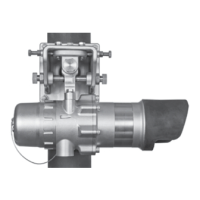
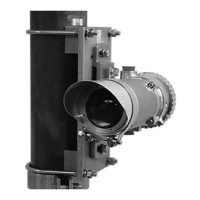
Module mounting options include:
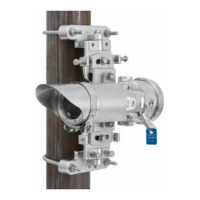
• A vertical or horizontal post with a nominal
outside diameter of 4.5” (11.43 cm).
Acceptable outside diameter range is 4” to 4
5/8” (10.16 to 11.75 cm). See Figure 7.
• Forflatsurfacemounting,refertoFigure8.
NOTE
Anti-seize material (provided) must be
applied to the U-bolt threads at the time of
installation to prevent galling.
NOTE
To ease installation and future removal,
all threaded covers, stopping plugs,
and thread adapters must be installed
using thread lubricant. See Ordering
Information for part number — avoid the
use of silicone grease. For devices with
NPT threads, Teflon tape or thread seal
lubricant must be used for enhanced
sealing capability. A minimum torque of
20 foot-pounds is required to maintain
ingress protection. To maintain the IP or
NEMA ratings when using NPT stopping
plugs, one to three wraps of Teon tape is
required.




 To Next Page