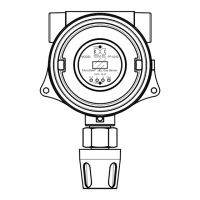
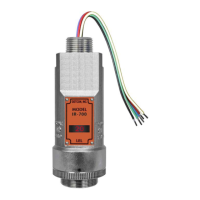
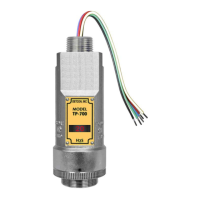
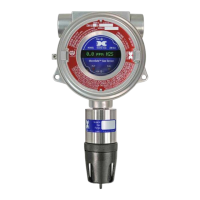
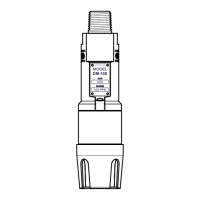
Model FP-700
FP-700 Instruction Manual Rev. 5.1 Page 6 of 46
8. The screws holding down the retaining plate label are special fasteners of type Stainless Steel Phillips
Pan-head Machine screw, M3 x 0.5, 6g6h having yield strength of greater than 40,000 PSI, typical
80,000 PSI. If screw requires replacement, only an identical screw may be used.
9. Proper precautions should be taken during installation and maintenance to avoid the build-up of static
charge on the plastic components of the sensor. These include the splashguard and splashguard adapter.
10. Do not operate the sensor outside of the stated operating temperature limits.
11. Do not operate the sensor outside the stated operating limits for voltage supply.
12. These sensors meet EN60079-0:2012:A1:2013, EN60079-1:2007.
2.2 Sensor Placement
Selection of sensor location is critical to the overall safe performance of the product. Seven factors play an
important role in selection of sensor locations:
(1) Density of the gas to be detected
(2) Most probable leak sources within the industrial process
(3) Ventilation or prevailing wind conditions
(4) Personnel exposure.
(5) Maintenance access.
(6) Personal Exposure.
(7) Oxygen is required in the background gas
Density
Placement of sensors relative to the density of the target gas is such that sensors for the detection of heavier than
air gases should be located within 4 feet of grade as these heavy gases will tend to settle in low lying areas. For
gases lighter than air, sensor placement should be 4-8 feet above grade in open areas or in pitched areas of
enclosed spaces.
NOTE: Methane and Hydrogen are lighter than air. Most other combustible gases are heavier
than air. Compare the molecular weight, density, or specific gravity of the target gas(es) with
that of air to determine appropriate placement.
Leak Sources
The most probable leak sources within an industrial process include flanges, valves, and tubing connections of
the sealed type where seals may either fail or wear. Other leak sources are best determined by facility engineers
with experience in similar processes.
Ventilation
Normal ventilation or prevailing wind conditions can dictate efficient location of gas sensors in a manner where
the migration of gas clouds is quickly detected.
Personnel Exposure
The undetected migration of gas clouds should not be allowed to approach concentrated personnel areas such as
control rooms, maintenance or warehouse buildings. A more general and applicable thought toward selecting
sensor location is combining leak source and perimeter protection in the best possible configuration.


 To Next Page