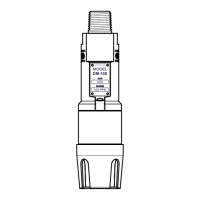
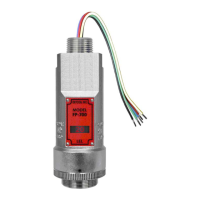
Model FP-700
FP-700 Instruction Manual Rev. 5.1 Page 28 of 46
3.6.2 Fault Diagnostic/Failsafe Features
Fail-Safe/Fault Supervision
Model FP-700 sensors are designed for Fail-Safe operation. If any of the diagnostic faults listed below are
active, the ITM Display will alternately scroll the message “Fault Detected” during normal operation. At any
time while the “Fault Detected” message is scrolling, hold the programming magnet over PGM2 for 1 second to
display the active fault(s). All active faults will then be reported sequentially.
Most fault conditions result in failed operation of the sensor and in those cases the 4-20mA signal is dropped to
the universal fault level of 0mA. These include the AutoZero and AutoSpan Calibration faults, Bridge Fault,
Sensor Fault, Processor Fault, Memory Fault, Loop Fault, and Input Voltage Fault. The 0mA fault level is not
employed for a Temperature Fault and AutoSpan Reminder Fault. For all diagnostic faults, the associated RS-
485 Modbus™ fault register will be flagged to alert the user digitally.
NOTE: Refer to the Troubleshooting Guide section 6 for guidance on fault conditions.
Zero Fault
If the sensor drifts below –10% LEL, the “Zero Fault” will be declared. A “Zero Fault” will cause a “Fault
Detected” message to scroll once a minute on the ITM display and drop the 4-20mA output to 0mA. The
Modbus™ fault register bit for Zero Fault will be set and will not clear until the fault condition has been cleared.
The sensor should be considered “Out-of-Service” until a successful AutoZero calibration is performed.
Range Fault – AutoSpan
If the sensor fails the minimum signal (Section 3.4.2) change criteria during AutoSpan sequence, the “Range
Fault” will be declared. A “Range Fault” will cause a “Fault Detected” message to scroll once a minute on the
ITM display and drop the 4-20mA output to 0mA. The Modbus™ fault register bit for Range Fault will be set
and will not clear until the fault condition has been cleared. The sensor should be considered “Out-of-Service”
until a successful AutoSpan calibration is performed.
Stability Fault – AutoSpan
If the sensor fails the signal stability criteria (Section 3.4.2) during AutoSpan sequence, the “Stability Fault” will
be declared. A “Stability Fault” will cause a “Fault Detected” message to scroll once a minute on the ITM
display and drop the mA output to 0mA. The Modbus™ fault register bit for Stability Fault will be set and will
not clear until the fault condition has been cleared. The sensor should be considered as “Out-of-Service” until
a successful AutoSpan calibration is performed.
Clearing Fault – AutoSpan
If the sensor fails the clearing criteria (Section 3.4.2) during AutoSpan sequence, the “Clearing Fault” will be
declared. A “Clearing Fault” will cause a “Fault Detected” message to scroll once a minute on the ITM display
and drop the milliamp output to 0mA. The Modbus™ fault register bit for Clearing Fault will be set and will
not clear until the fault condition has been cleared. The sensor should be considered as “Out-of-Service” until
a successful AutoSpan calibration is performed.
Sensor Fault
If either the active or reference detector should fail and become electrically open or the sensor was missing, a
“Sensor Fault” will be declared. A “Sensor Fault” will cause a “Fault Detected” message to scroll once a minute
on the ITM display. The Modbus™ fault register bit for Sensor Fault will be set and will not clear until the fault
condition has been cleared. If a Sensor Fault occurs, the 4-20mA signal will be set at 0mA until the fault
condition is resolved.


 To Next Page