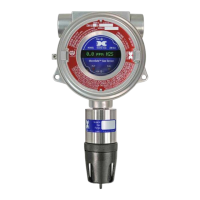
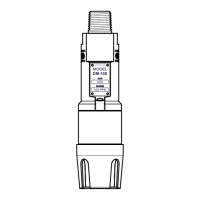
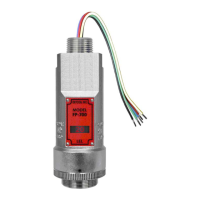
Model FP-700
FP-700 Instruction Manual Rev. 5.1 Page 1 of 46
1. Introduction
1.1 Description
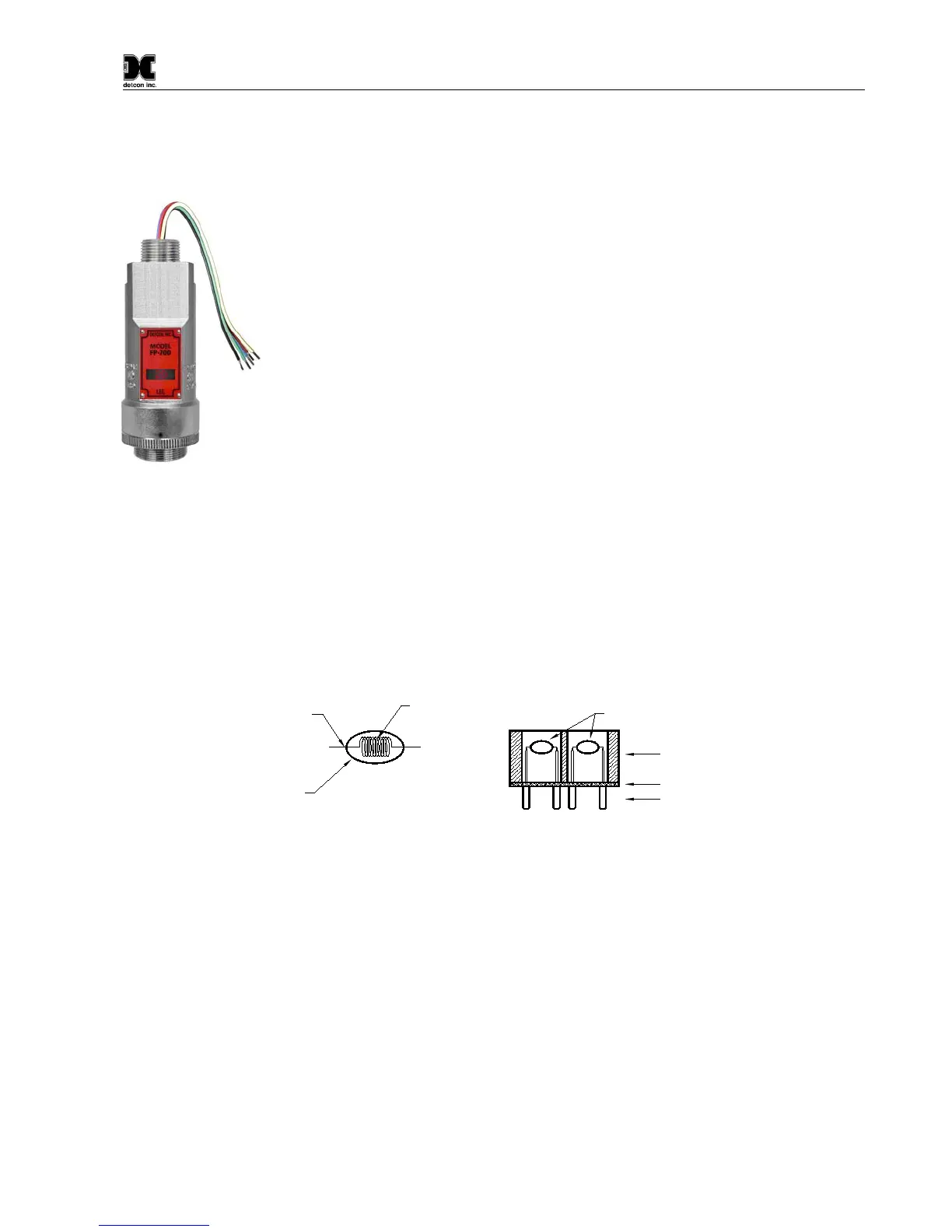
Detcon Model FP-700 combustible gas sensors are non-intrusive “Smart” sensors
designed to detect and monitor combustible gases in air. Range of detection is 0-100%
LEL or 0-50% LEL. The sensor features an LED display of current reading, fault and
calibration status. The unit is equipped with standard analog 4-20mA and Modbus™ RS-
485 outputs. A primary feature of the sensor is its method of automatic calibration, which
guides the user through each step via fully scripted instructions displayed on the LED
display.
The microprocessor-supervised electronics are packaged in an encapsulated module and
housed in an explosion proof casting. The unit includes a 4 character alpha/numeric LED
used to display sensor readings, and the sensor’s menu driven features when the hand-held
programming magnet is used.
Catalytic Bead (Pellistor) Sensor Technology
The sensor technology is a poison-resistant catalytic bead type. Catalytic bead sensors show a strong response
to a long list of combustible gases. The sensor is supplied as a matched-pair of detector elements mounted in a
plug-in replaceable module. One bead is a catalytically active detector and the other is a non-active reference
detector. Each detector consists of a fine platinum wire coil embedded in aluminum oxide. A catalytic mixture
is applied to the active detector while the reference detector is treated so that oxidation of the gas does not occur.
The technique is referred to as non-selective and may be used to monitor most any combustible gas. Detcon
catalytic bead sensors are specifically designed to be resistant to poisons such as sulfides, chlorides, and
silicones. The sensors are characteristically stable and capable of providing reliable performance for periods
exceeding 5 years in most industrial environments.
Figure 1 Sensor Cell Construction
Principle of Operation
Method of detection is by diffusion/adsorption. Air and combustible gases pass through a sintered stainless steel
filter and contact the heated surface of both the active and reference detectors. The surface of the active detector
promotes oxidation of the combustible gas molecules while the reference detector has been treated not to support
this oxidation. The reference detector serves as a means to maintain zero stability over a wide range of
temperature and humidity.
When combustible gas molecules oxidize on the surface of the active detector, heat is generated, and the
resistance of the detector changes. Electronically, the detectors form part of a balanced bridge circuit. As the
active detector changes in resistance, the bridge circuit unbalances. This change in output is conditioned by the
amplifier circuitry, which is an integral part of the sensor design. The response and clearing characteristics of
the sensor are rapid and provide for the continuous and accurate monitoring of ambient air conditions.
Main Housing Insert
Printed Circuit Board
Gold Plated Pins
Platinum Wire
Construction
of Detector
Bead
Catalyst
Alumina Bead
Catalytic Beads


 To Next Page