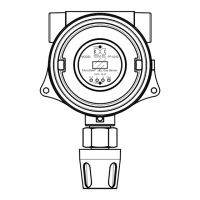
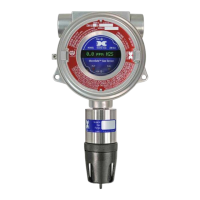
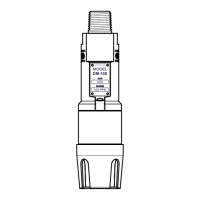
Model FP-700
FP-700 Instruction Manual Rev. 5.1 Page 7 of 46
Maintenance Access
Consideration should be given to providing easy access for maintenance personnel. Consideration should also
be given to the consequences of close proximity to contaminants that may foul the sensor prematurely.
NOTE: In all installations the gas sensor should point straight down, refer to Figure 13.
Improper sensor orientation may result in false readings and permanent sensor damage.
O2 in Sample Gas Background (Required)
CAUTION: Oxygen gas in the background is required for proper operation. The sensor will not perform as
specified if there are not normal levels of ambient Oxygen (~ 20.9% O2) present in the sample gas or
measurement environment. If there is zero O2 in the background, the sensor will not respond to combustible
gas at all. If there is somewhat less than 20.9% O2 available, then the sensor will read low.
Additional Placement Considerations
The sensor should not be positioned where it may be sprayed or coated with surface contaminating substances.
Painting sensor assemblies is prohibited.
Although the sensor is designed to be RFI resistant, it should not be mounted in close proximity to high-powered
radio transmitters or similar RFI generating equipment.
When possible in an area void of high wind, accumulating dust, rain or splashing from hose spray, direct steam
releases, and continuous vibration. If the sensor cannot be mounted away from these conditions then make sure
the Detcon Harsh Environment Splashguard accessory is used.
Do not mount in locations where temperatures will exceed the operating temperature limits of the sensor. Where
direct sunlight leads to exceeding the high temperature-operating limit, use a sunshade to help reduce
temperature.
2.3 Sensor Contaminants and Interference
Detcon combustible gas sensors may be adversely affected by exposure to certain airborne substances. Loss of
sensitivity or corrosion may be gradual if such materials are present in sufficient concentrations.
The performance of the detector elements may be temporarily impaired during operation in the presence of
substances described as inhibitors. Inhibitors are usually volatile substances containing halogen compounds.
Inhibitors include halide compounds such as Cl
2
, ClO
2
, F
2
, HF, HCl, Br
2
, vinyl chloride, and methyl chloride.
Inhibition is typically a temporary effect and the detectors generally recover after short periods of operation back
in clean air.
Some background gases may act as poisoning agents and have a more damaging effect on the sensor. Although
the sensor is designed to be poison resistant, it does have physical limits. Poisoning gases deactivate the active
detector’s catalytic ability and cause a permanent reduction in the span sensitivity. Examples of typical poisons
are: silicone oils and greases, siloxanes (HMDS), H
2
S, anti-knock petrol additives, and phosphate esters.
Activated carbon filters can be used to provide additional protection from poisoning in most cases.
The presence of such inhibitors and poisons in an area does not preclude the use of this sensor technology,
although it is likely that the sensor lifetime will be shorter as a result. Use of this sensor in these environments
may require more frequent calibration checks to ensure safe system performance.


 To Next Page