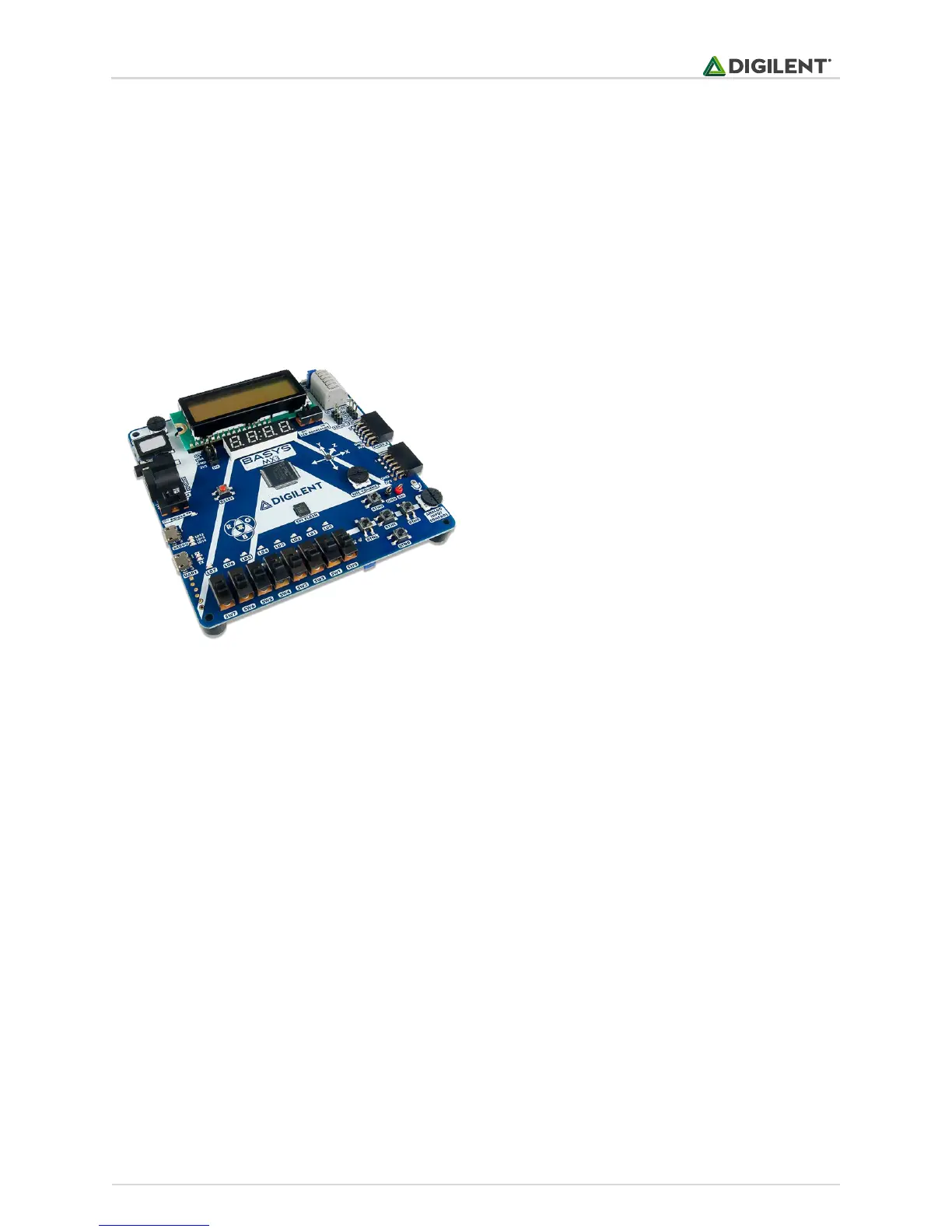
Basys MX3™ Board Reference Manual
Copyright Digilent, Inc. All rights reserved.
Other product and company names mentioned may be trademarks of their respective owners.
Overview
The Basys MX3 is a true MCU trainer board designed from the ground up around the teaching experience. Basys
MX3 features the PIC32MX370 from Microchip and was designed to be used with the MPLAB® X IDE. With an
exhaustive set of peripherals, students gain exposure to a wide range of embedded systems related concepts while
using a professional grade tool set. Accompanied by free and open source coursework, including seven in-depth
teaching units and 15 complete labs, the Basys MX3 is a versatile MCU trainer board ideal for teaching introductory
embedded systems courses.
Switches, Push-buttons, LEDs,
and Displays:
Audio, Motor Control, and Other
Devices:
Powered from USB or
any 5V external power
source
USB and Debugging:
USB-UART Bridge
USB
programmer/debugger
30-pin Analog Discovery
2 connector
5 Push-buttons
1 Reset button
8 Slide switches
8 LEDs
1 RGB LED
4-digit 7-segment display
LCD character display
Expansion Connectors:
Two standard Pmod ports
o 16 Total
microcontroller I/O
One I2C Connector
o 2 Total
microcontroller I/O
Speaker with Audio Output Jack
and volume control
Microphone with volume
control
Dual H-Bridge Motor Driver for
up to two 1.5 A Brushed DC
Motors or one stepper motor
2 Servo Connectors
FIR-compatible IrDA Module
Potentiometer
3-axis, 12-bit accelerometer
4 MB SPI Flash
PIC32MX370F512L Microcontroller
MIPS32® M4K® core runs up to
96 MHz using onboard 8 MHz oscillator
512 KB of Program Flash Memory, 12 KB
of Boot Flash Memory
128 KB of SRAM
Four Direct Memory Access (DMA)
Modules
Two SPI, Two I²C, and Five UART serial
interfaces
Parallel Master Port (PMP) for graphics
interfaces
Five 16-bit Timers/Counters
Five Input Capture Modules
Five Output Compare Modules
85 I/O pins
o 54 pins support Peripheral Pin
Select (PPS) for function
remapping



 To Next Page