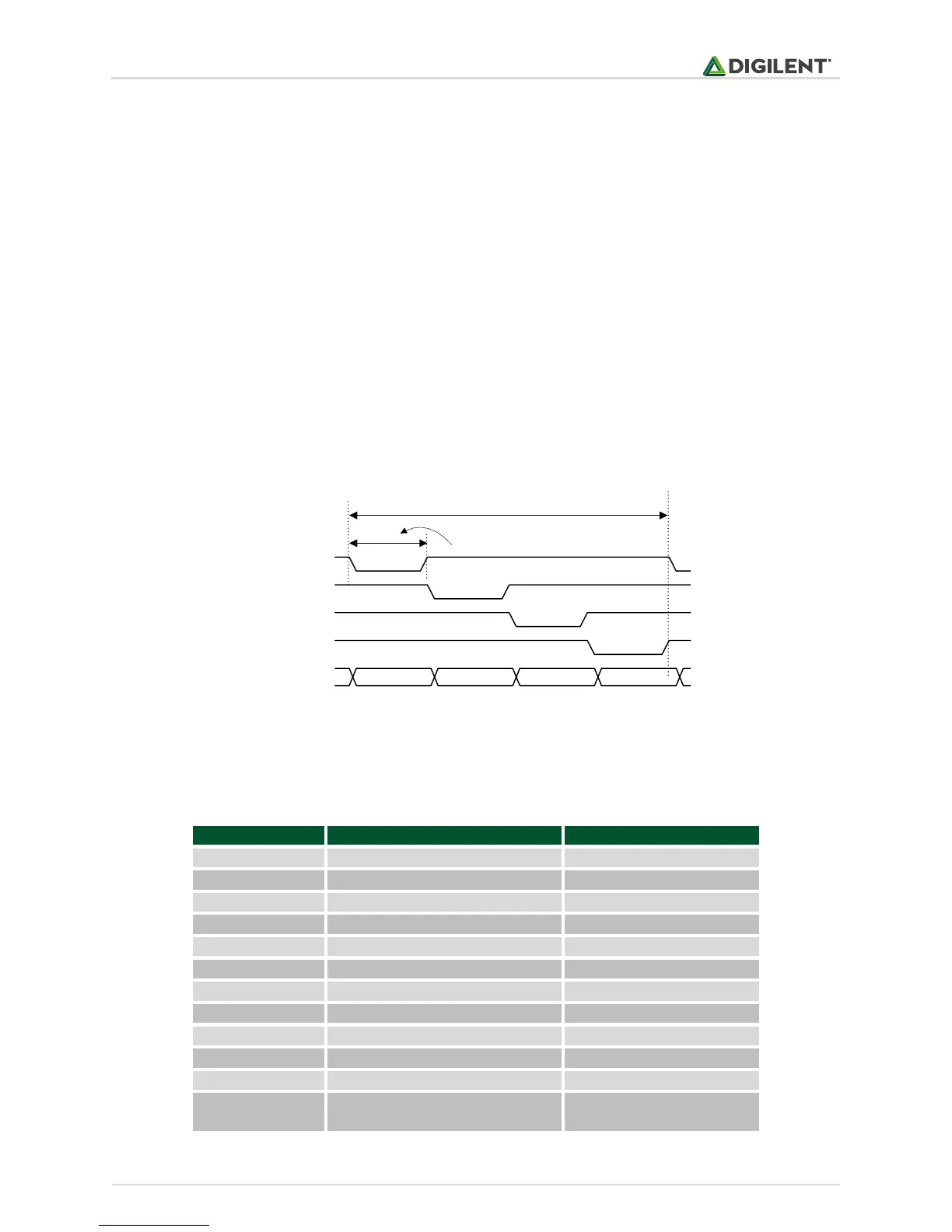
A scanning display controller circuit can be used to show a 4-digit number on this display. This circuit drives the
anode signals and corresponding cathode patterns of each digit in a repeating, continuous succession at an update
rate that is faster than the human eye can detect. Each digit is illuminated just one-fourth of the time, but because
the eye cannot perceive the darkening of a digit before it is illuminated again, the digit appears continuously
illuminated. If the update, or “refresh”, rate is slowed to around 45Hz, a flicker can be noticed on the display.
To make each of the four digits appear bright and continuously illuminated, all should be driven once every 1 to
16ms, with a refresh frequency of about 1kHz to 60Hz. For example, if every digit is refreshed every 3ms,
corresponding to a frequency of 333Hz, the entire display will be refreshed every 12ms. The controller must drive
low the cathodes with the correct pattern when the corresponding anode signal is driven high.
To illustrate the process:
1. If AN0 is asserted while CB and CC are asserted, then a “1” will be displayed in digit position 1.
2. If AN1 is asserted while CA, CB, and CC are asserted, a “7” will be displayed in digit position 2.
3. If AN0, CB, and CC are driven for 4ms, and then AN1, CA, CB, and CC are driven for 4ms in an endless
succession, the display will show “71” in the first two digits. An example timing diagram for a four-digit
controller is shown in Fig. 7.4.



 To Next Page