25
FEED FORCE ADJUSTMENTS (Continued....)
4. Upward saw head movement during automatic cycle
is made with the head clear proximity sensor (3 or
2 PRS) is initiated. At this point: (a) The saw head
immediately raises to a height determined by the
sensing arm position; (b) Another stock length is
indexed; (c) The saw head lowers to start another
cut.
Head Approach
1. After the stock has been positioned for cutting and
the Saw Head Control selector is placed at the
"DOWN/AUTO" setting, the saw head's approach
(descending) rate is regulated by the Head
Approach valve.
2. Correct head approach is important for helping: (a)
Determine overall cutting accuracy and nish of
cut; (b) Improve blade life by eliminating breakage
and tooth strippage at the cut's start and break-out
points.
3. To lower the saw head if the band drive motor is not
running: (a) Place the saw in "MANUAL" operating
mode; (b) Move the Saw Head Control selector to
"DOWN/AUTO"; (c) Raise and lock the stock height
sensing arm; (d) Make the desired Head Approach
valve setting; (e) The stock height sensing arm can
now be unlocked. The saw band must be running
when the arm contacts the workpiece.
AUTOMATIC HEAD ELEVATION and SENSING
ARM (Auto Mode Only)
Head Elevation
1. Saw head elevation during automatic sawing cycle
is initiated when the head down proximity switch
(2 PRS or 2 LS) is actuated. The saw head then
raises to a height determined by the sensing arm.
2. After a cut has been made in the manual operating
mode, the actuated head down proximity switch (2
PRS or 2 LS) stops machine operation. To lift the
saw head off the limit switch and resume operation,
the operator must; (a) Move the Saw Head Control
selector to "UP"; (b) Push the Hydraulic Start
button.
Sensing Arm
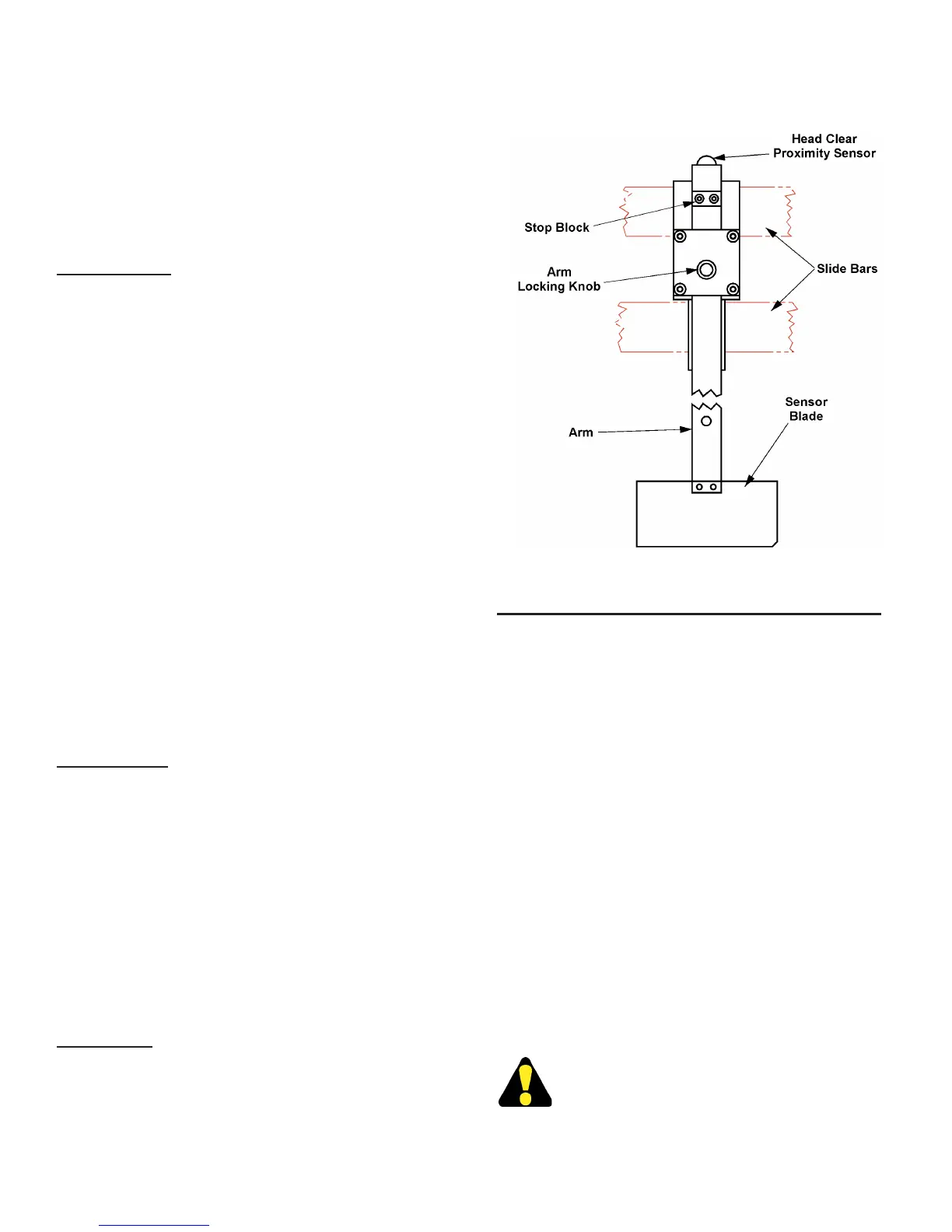
1. The sensing arm works in conjunction with the head
clear proximity switch (3 or 2 PRS) to assure that
the saw head has raised sufciently above existing
stock so that automatic indexing (or manual stock
positioning) can be accomplished safely.
2. The sensing arm can be moved horizontally by:
(a) Loosening the locking knob; (b) Sliding the arm
up or down to desired position; (c) Tightening the
locking knob.
Head Elevation Mechanism.
Sensing Arm Operation When the Saw Head Raises
1. The saw head lifts the sensing arm above the stock
at a rapid rate (there is no slow head raising rate)
until it actuates the head clear proximity switch (3 or
2 PRS). This causes saw head upward movement
to stop when the blade is approximately one (1)
inch (25.4 mm) above the stock. This clearance
anticipates potentially crooked and/or out-of-round
stock being used.
2. If operating in automatic mode, the xed vise then
unclamps, the index vise clamps, and stock is
indexed forward. Following the advance of stock, the
xed vise clamps and the index vise unclamps.
3. When the xed vise unclamps prior to indexing, its
jaws open just enough to allow stock advancement.
The vise jaws can be opened wider only when the
saw head has been manually raised to the full "UP"
position to actuate the head up proximity switch (9
PRS or 9 LS): this assures that the left saw guide
arm will clear the xed vise when it opens to receive
larger stock.
Left saw guide arm adjustment for stock width
must be made manually by the operator.
SAW HEAD POSITIONING & APPROACH
(Continued....)


 To Next Page