Donaldson Company, Inc.
36
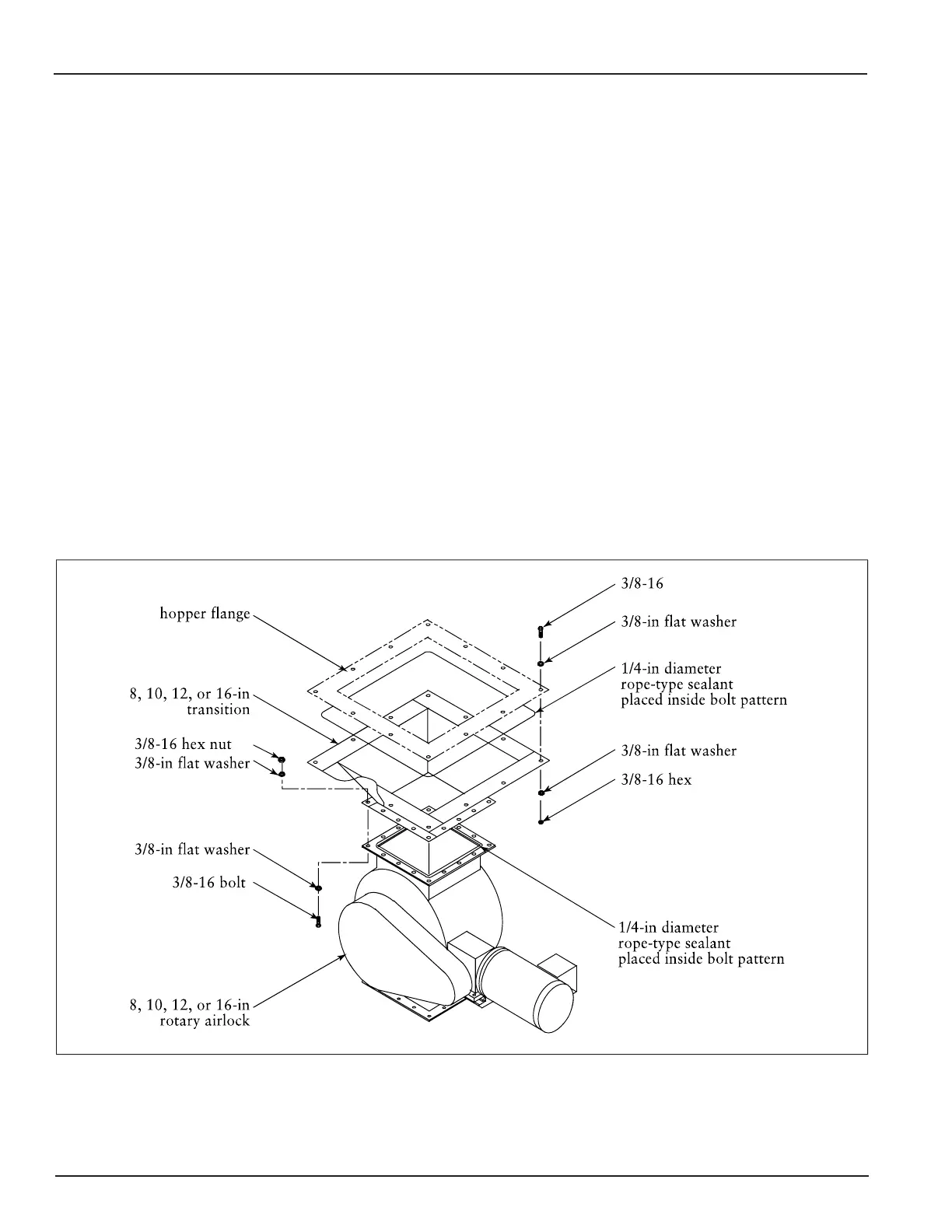
1. Place 1/4-in diameter rope-type sealant to the
inside of the transitions bolt pattern.
2. Use 3/8-16 bolts, washers, and hex nuts to fasten
transition to hopper.
3. Determine the proper position required for the
rotary airlock. Allow clearance for electrical
connections and future maintenance.
4. Place a 1/4-in diameter rope-type sealant toward
the inside edge of the airlocks top flange.
5. Fasten the airlock to the transition flange using
3/8-16 bolts, washers, and hex nuts.
6. Electrical connections must be made by a
qualified electrician. Refer to the motors
nameplate for voltage, amp rating, cycle, and
wiring sequence.
Transition and Rotary Valve
The 7-in tall transition is designed to connect a
standard hopper and a rotary valve. Rotary valves
are used as an airlock and a metering device in dust
control applications. When used as an airlock, an
airtight seal between the valves inlet and outlet is
maintained while allowing dust or material to pass
through. Comparatively, the airlock works along the
same line as a revolving door on a building; an
airtight seal is maintained while people are allowed
to pass through.
When used as a metering device, the valve allows a
specific amount of material to pass per revolution,
depending on the size and speed of the valve. Sizing
is determined at time of order and based on product
load. Standard sizes include 8, 10, 12, and 16-in inlets.
Transition and Rotary Valve Assembly



 To Next Page