VigorAP 710 User’s Guide
88
However, when stations have various data rate (e.g., 11g, 11n), the result is not fair. The
slow stations (11g) work in their slow data rate and occupy too much airtime, whereas the
fast stations (11n) become much slower.
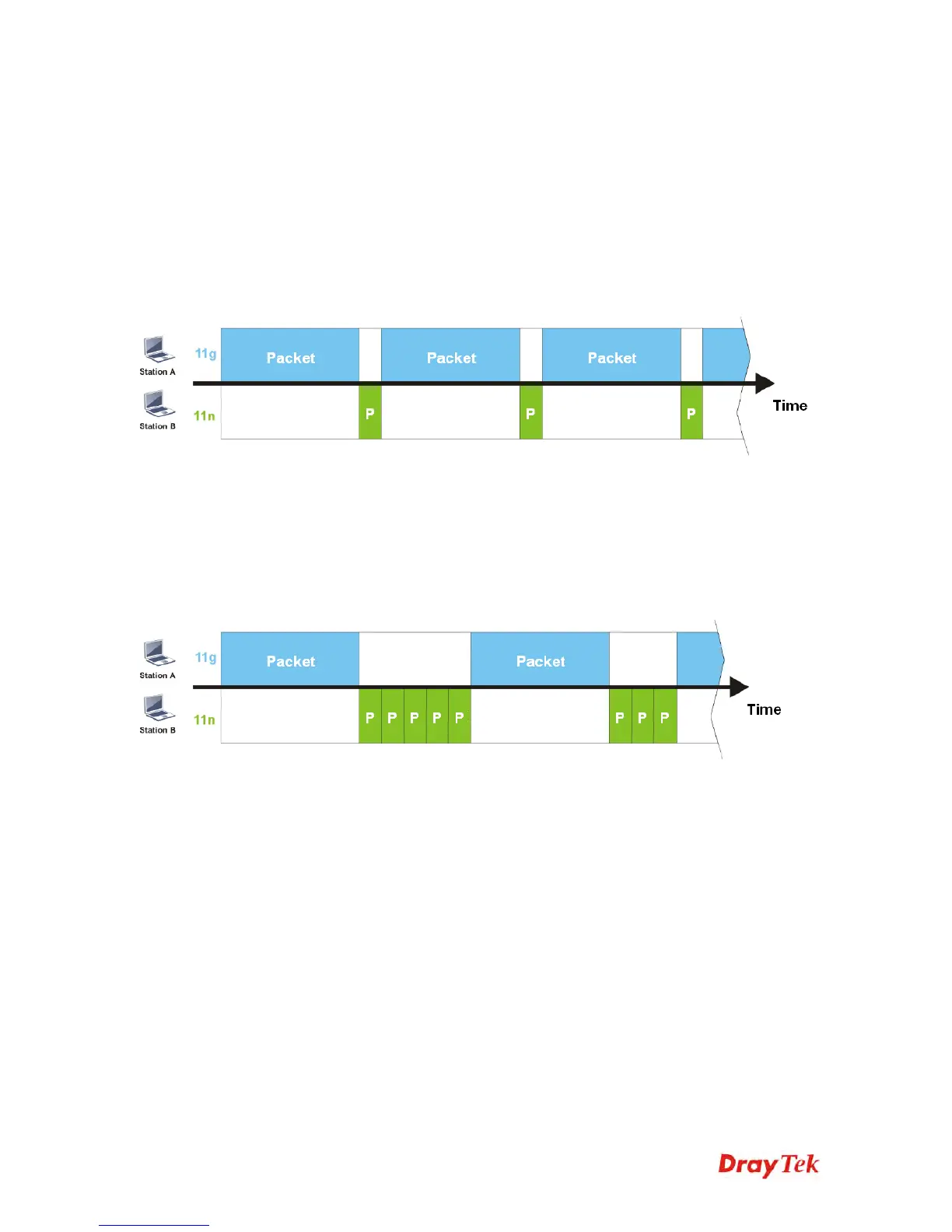
Take the following figure as an example, both Station A(11g) and Station B(11n) transmit
data packets through VigorAP 710. Although they have equal probability to access the
wireless channel, Station B(11n) gets only a little airtime and waits too much because Station
A(11g) spends longer time to send one packet. In other words, Station B(fast rate) is
obstructed by Station A(slow rate).
To improve this problem, Airtime Fairness is added for VigorAP 710. Airtime Fairness
function tries to assign similar airtime to each station (A/B) by controlling TX traffic. In the
following figure, Station B(11n) has higher probability to send data packets than Station
A(11g). By this way, Station B(fast rate) gets fair airtime and it's speed is not limited by
Station A(slow rate).
It is similar to automatic Bandwidth Limit. The dynamic bandwidth limit of each station
depends on instant active station number and airtime assignment. Please note that Airtime
Fairness of 2.4GHz and 5GHz are independent. But stations of different SSIDs function
together, because they all use the same wireless channel. IN SPECIFIC ENVIRONMENTS,
this function can reduce the bad influence of slow wireless devices and improve the overall
wireless performance.
Suitable environment:
(1) Many wireless stations.
(2) All stations mainly use download traffic.
(3) The performance bottleneck is wireless connection.








 To Next Page