Safety
5
• During operation, the housing warms up and surface temperatures > 60°C may
occur. To prevent possible burns, we recommend checking the surface temperat-
ure using an appropriate thermometer and wearing protective gloves, prior to
working on the device.
Protective measures The end user or the contractor are responsible for implementing required protective
measures on site, such as enclosures, barriers, or personal protective equipment for
the staff.
Maintenance To ensure safe device operation, the maintenance instructions included in this manual
must be observed.
Any device modification requires prior written consent of the manufacturer.
1.2
Range of application
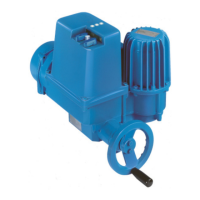
DREHMO actuators are designed for the operation of industrial valves, e.g. globe
valves, gate valves, butterfly valves and ball valves.
If temperatures are to be expected at the valve flange or the valve stem, which exceed
the permissible ambient temperatures, (e.g. due to hot media), please consult the
manufacturer. Other applications require explicit (written) confirmation by the manu-
facturer. The following applications are not permitted, e.g.:
• Industrial trucks according to ENISO3691
• Lifting appliances according to EN14502
• Passenger lifts according to DIN15306 and 15309
• Service lifts according to EN81-1/A1
• Escalators
• Continuous duty (S1)
• Buried service
• Continuous underwater use (observe enclosure protection)
• Potentially explosive atmospheres (except the explosion-proof version)
• Potentially explosive atmospheres of group I (mining)
• Radiation exposed areas in nuclear power plants
No liability can be assumed for inappropriate or unintended use. Observance of these
operation instructions is considered as part of the device's designated use.
Information: These operation instructions are valid for the clockwise closing standard
version, i.e. driven shaft turns clockwise to close the valve.
1.3
Warnings and notes
The following warnings draw special attention to safety-relevant procedures in these
operation instructions, each marked by the appropriate signal word (DANGER,
WARNING, CAUTION, NOTICE).
DANGER
Indicates an imminently hazardous situation with a high level of risk.
Failure to observe this warning results in death or serious injury.
WARNING
Indicates a potentially hazardous situation with a medium level of risk.
Failure to observe this warning could result in death or serious injury.
CAUTION
Indicates a potentially hazardous situation with a low level of risk. Fail-
ure to observe this warning could result in minor or moderate injury. May
also be used with property damage.


 To Next Page