Leaders in Pipeline Survey Systems
OPERATOR’S MANUAL
Issue 4.04 - 1207 27
Continue the survey.
NOTE: on the next SEARCH screen the survey number has been incremented to S#01 (the first
survey is survey S#00). The point counter increments and does not
reset to zero.
Referring to the survey list, continue through to Survey 4. Note that on Survey 4 there is no GPS
data. You can choose your own distances to see how the effect of distance changes the
readings (try negative distances – this indicates a change of direction in surveying.
If you need to go over this again, go to the CLEAR MEMORY menu and start again. Continue
doing this until you are happy with the controls and procedure. NOTE: Switching off disables
Demo Mode. The readings made during Demo are still retained in memory.
4.4. Notes on entering distances
The distance that is entered is crucial to calculating the correct attenuation, hence It is very
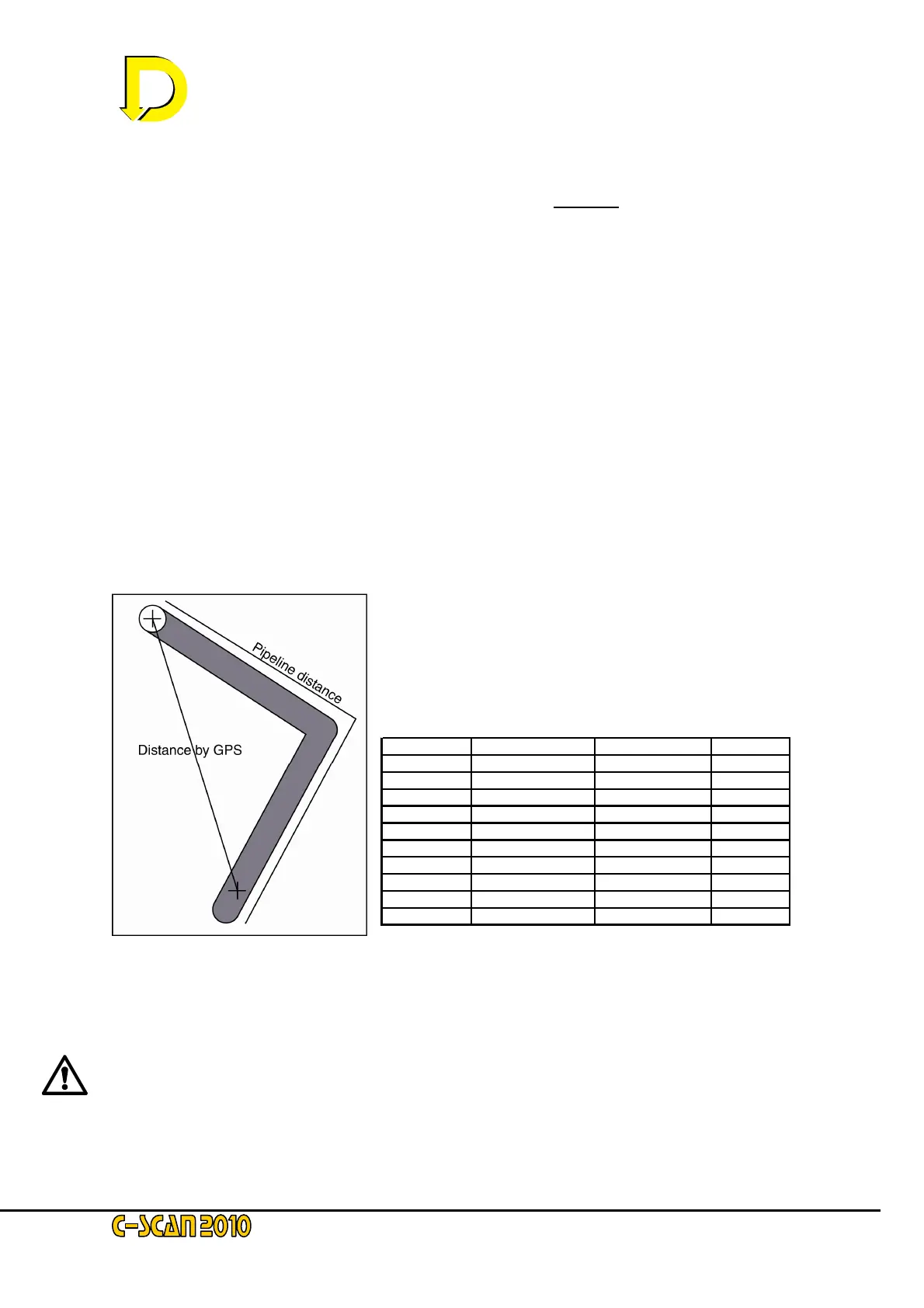
important that this value is correct. Remember that the distance entered relates to pipeline
distance, not the direct distance between two points.
If two successive points are taken around a bend in a pipe and GPS is being used, it is
important to enter the pipeline distance and NOT use the GPS distance, as this will cause an
error.
Due to magnetic field distortion (the operating design of
C-Scan relies on magnetic field) at bends of more than
30
0
, reliable readings cannot be taken at sharp bends -
see the Survey Procedure manual. The table below
shows the error for two readings taken 50m either side
of a bend with different angles if a direct line is taken.
Bend angle Pipeline Distance Direct distance % error
0 100 100 0
10 100 100 0
20 100 98 2
30 101 97 3
40 102 94 7
50 103 91 11
60 104 87 16
70 105 82 21
80 106 77 27
90 107 71 33
To produce a positive (+ve) attenuation, the reading taken must be less than (<) the last
reading AND the distance must be positive (+ve). If the distance is negative (-ve), the
attenuation will be negative. A negative attenuation is hard to visualise in relation to
positive attenuations, but the main rule of thumb is:
Going away from the generator distances are positive (+ve).
Going towards the generator distances are negative (-ve)



 To Next Page