Miscellaneous
ICC1300-1EN3.pdf 2011-10-10
Towing the roller
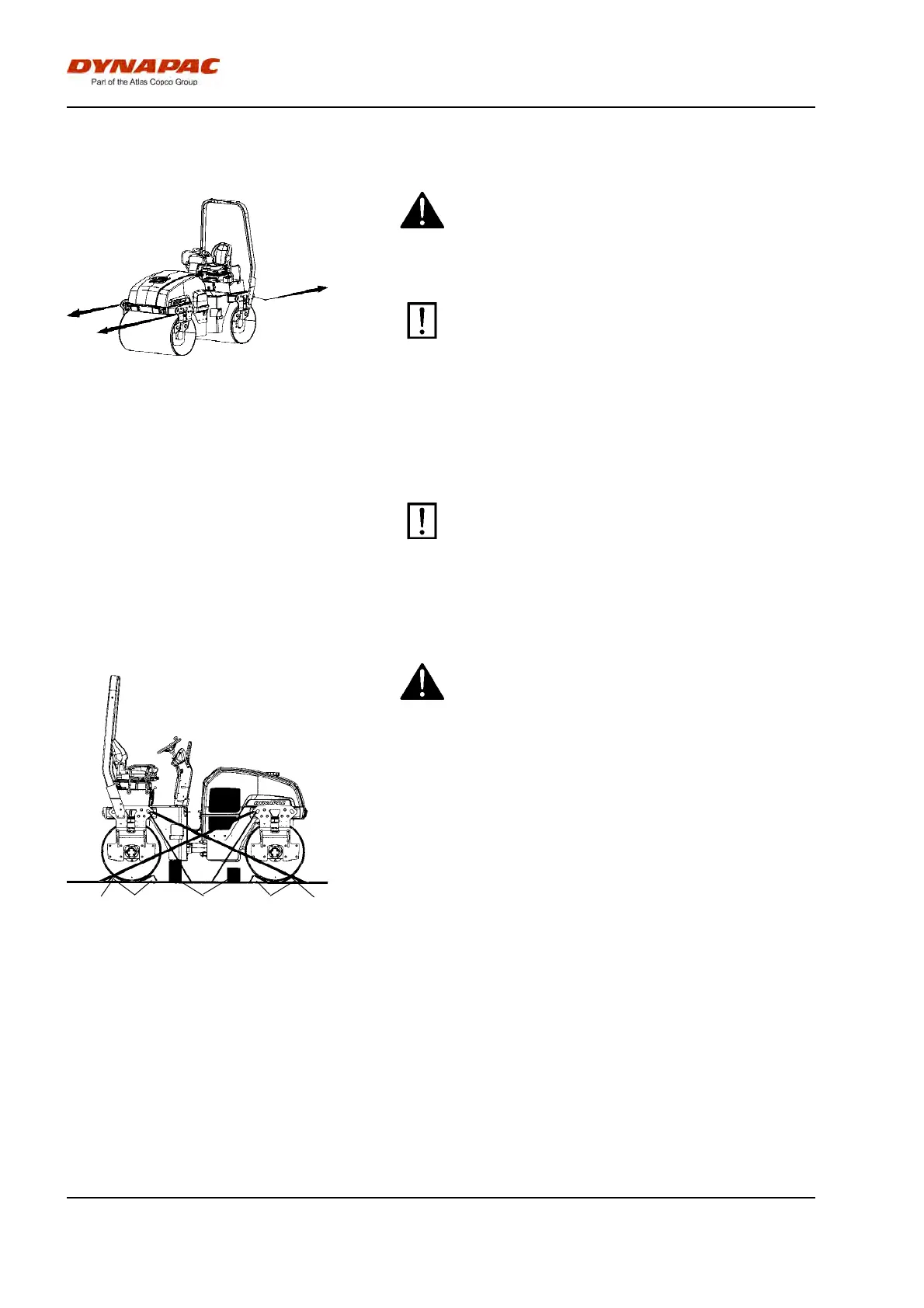
Fig. Towing
The roller must be counter-braked during
towing/recovery. Always use a towbar. There is no
braking capacity on the roller now.
The roller must be counter-braked during
towing/recovery. Always use a towbar. There is no
braking capacity on the roller now.
The roller must be towed slowly, max. 3 kph (2
mph) and only towed short distances, max. 300 m
(1000 ft).
The roller must be towed slowly, max. 3 kph (2
mph) and only towed short distances, max. 300 m
(1000 ft).
When towing/retrieving a machine, the towing device
must be connected to both lifting holes. The pulling
force shall act longitudinally on the machine as shown
in the figure. Maximum total pulling force 130 kN
(29225 lbf).
Reverse the towing preparations.Reverse the towing preparations.
Roller prepared for transport
Fig. Arrangement
1. Chocks
2. Wooden blocks
3. Lashing straps
33 12
1
Lock the articulation before lifting and
transporting. Follow the instructions under the
relevant heading.
Lock the articulation before lifting and
transporting. Follow the instructions under the
relevant heading.
Activate the parking brake.
Make sure that the machine is in a neutral position, i.e.
that the drums are in line.
Chock the drums (1) and secure the chocks to the
transport vehicle. The drums should be chocked both
forwards and backwards.
Block up under the drum frame (2), to avoid
overloading the rubber suspension when lashing.
Block up the machine as shown in figure.
Secure down the roller with lashing straps (3) at all
four corners. The attachment points are shown on the
decals. Place the chains in symmetrical pairs crossing
each other.
50



 To Next Page