22
With battery power applied, the 4-in-1 unit status LED will blink red, and then blink green. It is
extremely important that you do not move or sway the helicopter once the status LED begins to
blink green confirming that the initialization process and calibration of the gyro has begun. It is OK
to move the model when the status LED is blinking red (as in the time it takes to connect the flight battery to
the 4-in-1 unit and place the model at rest), as long as the model remains motionless when the status LED
begins to blink green.
When the status LED becomes solid green, the unit is armed and ready for flight. Use caution as both
main motors will now run with throttle stick or throttle trim input. Do not advance the throttle stick or trim until
you are clear of the rotor blades and ready to fly.
Note: If the status LED does not become solid green, please review the following:
• If after blinking red the status LED becomes solid red, you have a positive Radio Frequency (RF) link between
the transmitter and receiver of the 4-in-1 unit, but the throttle stick and throttle trim may not be in their lowest
possible positions. Check to be sure that both the throttle stick and throttle trim are in their lowest possible
position and the status LED should blink green then become solid green indicating the unit is armed and ready for
flight. Proceed to the next step of the checklist once the unit is armed.
• If after blinking red the status LED continues to flash from green to red, you do not have a positive RF link
between the transmitter and receiver of the 4-in-1 unit. First, check to be sure that the transmitter has been
powered on and has an adequate level of battery power. If the transmitter was indeed powered on, power both
the transmitter and 4-in-1 unit down, then follow the steps to bind the 4-in-1 unit’s receiver to the transmitter (see
pages ** to ** for more information). Once you have confirmed that the transmitter and receiver are properly
bound, the 4-in-1 unit should now arm normally.
If your 4-in-1 unit will not arm after following the guidelines as listed above, contact Horizon Hobby’s Product
Support staff at 877-504-0233.
Once you have placed the helicopter in a safe area to test motor control, free from obstructions,
and are clear of the rotor blades, you can safely begin to power up the model.
Advance the throttle (left-hand) stick slowly, just until the main rotor blades begin to spin. Be sure not to
advance the throttle stick too far to keep the helicopter from lifting off the ground. Note the direction that each
of the main rotor blades spins. When viewed from the top, the lower main rotor blade should spin clockwise
and the upper main rotor blade should spin counterclockwise. If either rotor blade is operating in the wrong
direction, unplug the battery, then simply reverse its motor plug polarity on the 4-in-1 unit. Note that the proper
polarity is marked on the label of the 4-in-1 unit.
After confirming that the direction of rotation for both rotor blades is correct, it is best to confirm that both
rotor blades respond properly to rudder control inputs. With both main rotor blades spinning at a low level of
power, move the rudder (left-hand) stick all the way to the right. This should cause the speed of the upper main
rotor blade to increase, and the speed of the lower main rotor blade to decrease. Next, move the rudder stick
all the way to the left. This should cause the speed of the lower main rotor blade to increase and the speed
of the upper main rotor blade to decrease. If both rotor blades are not responding properly to rudder input,
simply reverse the locations of their motor plugs on the 4-in-1 unit. Note that the proper motor plug locations
are marked on the label of the 4-in-1 unit.
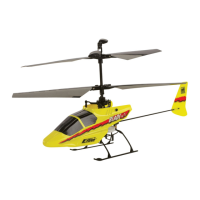
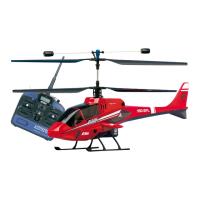
After confirming both main rotor blades respond properly to rudder inputs, your Blade™ CX2 is now ready
for flight. However, please be sure to review the following sections of the manual before proceeding with the
first flight.




 To Next Page