30
Choosing a Flying Area
When you are ready for your first flight, you will want to select a large, open area that is free of people and
obstructions. We strongly recommend an indoor area with at least 20-feet by 20-feet of floor space and
no less than 8-foot ceilings.
If you have to make your first flight (and subsequent flights) outdoors, you MUST pick a time when wind
conditions are COMPLETELY CALM. Due to the relatively small size and low weight of the Blade™ CX2, even the
slightest amount of wind can cause you to lose control, or the rotor blades to strike each other, resulting in a crash.
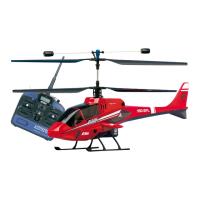
Flying the Blade CX2
Having followed the proper 4-in-1 control unit arming procedure, confirmed proper control of the servos
and motors, and found a suitable flying area, your Blade CX2 is ready for flight.
In addition to reviewing the flight maneuvers outlined below, we recommend that you watch the included
Instructional Video CD to see many of these maneuvers and adjustments performed by the Blade CX2 and pilot.
• Slowly raise the throttle stick, increasing the speed of the main rotor blades until the model begins to lift off. Do
not raise the throttle stick too quickly as the model could climb too fast causing you to lose control or
make contact with objects above.
• Lift the model off the ground just a few inches and concentrate on balancing the left-hand (throttle) stick position
so that the model holds a steady hover altitude. In some cases it may be best to make a few short “hops” to
an altitude of just a few inches until you become familiar with the control inputs and trim settings required to
maintain a steady hover and altitude.
As you will find, the Blade CX2 requires minor throttle adjustments to maintain its altitude in hover. Remember
to keep these throttle adjustments as minimal as possible as large adjustments could result in a loss of control
and/or a possible crash.
• While attempting to establish a low-level hover, you can also check to see if any trim adjustments are required to
help keep the Blade CX2 from constantly drifting in various directions. If you find the helicopter constantly drifts
without any directional control input, it will be best to land the model before making any adjustments to the trim
levers. Additional details regarding the location and function of the trim levers can be found on pages 26–29.
If the nose of the helicopter is drifting to the left or right, you will need to adjust the rudder trim. You
can also adjust the Main Motor Proportional Mix if you experience any difficulties in trimming nose drift with the
rudder trim lever only. Please see pages 32–33 for more information regarding Main Motor Proportional Mix
Trimmer Pot adjustment.
If the helicopter is drifting forward or backward, you will need to adjust the elevator trim.
If the helicopter is drifting to the left or right, you will need to adjust the aileron trim.
Continue to make trim adjustments until the helicopter can hover at a low altitude with very little drifting and
directional control input. If the Blade CX2 is your first helicopter model, it may be best to have the help of an
experienced helicopter pilot to trim the model for you before making your first flight.
• Once you have the Blade CX2 properly trimmed and maintaining a stable low-level hover, practice using the
rudder, elevator and aileron controls to get a feel for how the helicopter responds to control inputs. Remember to
keep the control inputs as minimal as possible to prevent over-controlling the helicopter, especially when in hover.



 To Next Page