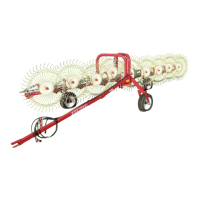
The device described in the manual is an RT 7-9 Hay Rake, manufactured by ENOAGRICOLA ROSSI s.r.l. It is an agricultural implement designed for collecting previously cut forage.
Function Description
The hay rake is an agricultural equipment used to collect any type of previously cut forage, creating windrows (straights of cut hay) which can then be harvested by a special baler. The RT 7-9 models are semi-mounted, meaning they are attached to an agricultural tractor for operation. The rake's functioning is achieved through its trailing by the tractor and the rotary movement of its hay wheels, which collect the cut forage with their teeth.
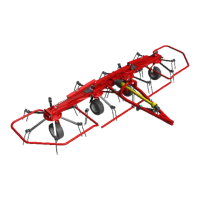
The machine features a flexible and strong frame, allowing it to work effectively on various types of soil, including hilly terrain. Each hay wheel (ranging from 7 to 9 wheels, depending on the model) operates independently, equipped with a shock-absorbing spring that enables it to follow the contours of the soil. Hydraulic cylinders control the movement of the arms and hay wheels, as well as the alignment of the rear wheel to the tractor in the hydraulic version. These hydraulic functions are powered by the tractor's auxiliary hydraulic system and controlled via levers in the tractor cabin.
The rake's working configuration allows it to gather cut forage and collect it into a central windrow, which can be up to 6 meters wide. This design aims to facilitate the working process and reduce final costs.
Important Technical Specifications
The manual provides a table with technical data for two models: RT 7 and RT 9.
Model RT 7:
- Raking wheels (VICON): 7 wheels
- Teeth per wheel: 40
- Ø cm: 7.59
- Working width: 350 cm
- Transport width: 200 cm
- Wheels (Type): 205/70.15
- Wheels (N°): 3
- HP: 30
- Weight: 645 Kg
Model RT 9:
- Raking wheels (VICON): 9 wheels
- Teeth per wheel: 40
- Ø cm: 7.59
- Working width: 450 cm
- Transport width: 200 cm
- Wheels (Type): 205/70.15
- Wheels (N°): 3
- HP: 30
- Weight: 735 Kg
The machine requires a minimum tractor power of 30 HP for both models. It is designed to be installed on agricultural tractors with a universal three-point hitch system and rear hydraulic connection. Tractors must be equipped with protective roll-bar or ROPS/FOPS approved cabins.
Usage Features
Installation and Transport:
The hay rake is delivered disassembled and requires assembly before use. For transport, it must be attached to an agricultural tractor and configured in its transportation mode. This involves lifting the hay wheels, closing the mobile frame (using a mechanical block and tractor reverse movement), applying a locking pin to the rear wheel, and securing the jack rod positioning hay wheels with a safety plug. The device is not approved for road circulation and is only allowed to be transported on fields.
Operation:
- Preparation: Before starting, ensure all parts are securely fitted, the rake is properly attached to the tractor, all protection devices are efficient, and daily maintenance checks are performed.
- Hay Wheel Weight Adjustment: The effectiveness of forage collection depends on the hay wheels' weight on the soil. This can be adjusted using a knob on the mobile frame. The ideal weight is when the teeth are almost touching the ground; too low can cause rapid wear, and too high can be ineffective. Turning the knob clockwise lightens the wheels, counter-clockwise makes them heavier.
- Speed: During operations, the tractor speed should always be maintained within 3 km/h.
- Direction Change and Reverse: When changing direction or reversing, the hay wheels must be lifted from the ground, and if necessary, the equipment should be put into transport configuration.
- Visibility: Operations should only be carried out in good visibility and lighting conditions.
- Safety Zones: Operators must ensure no persons or animals enter the dangerous areas around the rake during operation.
Safety Precautions:
- Only qualified and trained adult personnel should operate the rake.
- Never use the equipment with broken or damaged parts, especially protective ones.
- Opening and closing the mobile frame must occur with hay wheels raised.
- Movements of hay wheels and frame should be slow to avoid damage.
- For short stops, disengage the PTO, engage the parking brake, stop the tractor engine, and remove the key.
- Do not use the machinery if the cut product is wet or damp, as it can accumulate on teeth.
- Avoid operating near masonry to prevent damage to teeth and dangerous projection of residues.
- The operator is responsible for operational control, maintenance, and repairs.
Maintenance Features
The manual outlines periodic maintenance interventions to ensure the equipment's efficiency and longevity.
Warnings During Maintenance:
- All interventions must be carried out on a flat, well-lit surface, free from obstructions, with the equipment stable, tractor blocked, parking brake engaged, engine off, and keys removed.
- A "Machine under maintenance" sign should be applied to the tractor.
- Interventions must be completed once started.
- Always refer to the manual for instructions.
- Use appropriate tools and original spare parts.
- Clean the work area after maintenance.
- Exercise caution when checking for fluid leaks under pressure, as fluid can pierce the skin.
Maintenance Schedule:
- Daily Checks (before working):
- Verify integrity of all pipelines (connections, protections, hydraulic oil leakage).
- Weekly Checks (or per 50 operating hours):
- Verify integrity of all pipelines.
- Check hydraulic oil leakages on central wheel circuits and restore level if needed.
- Verify integrity of all adhesive labels.
- Check presence of safety pins and R pins.
- Verify structural integrity of all equipment parts, especially wear-prone parts like tire wheels.
- Check fastening of nuts and screws.
Lubrication (AGIP GR MU EP 2):
- Remove protective caps from greasers, clean them, inject grease using an appropriate pump, then clean excess grease and replace caps.
- Lubricant points are indicated by adhesive labels.
- Proper disposal of oil, lubricants, and filtering cartridges is mandatory to prevent environmental pollution.
Raked Wheel and/or Teeth Replacement:
- Rake Wheels: To replace a rake wheel, remove the six locking nuts and fastening screws, then take the wheel out of its connection. Install a new wheel by reversing the process.
- Teeth: To replace teeth, remove the block plate by removing two locking nuts, then take off the screws from their housings, and finally remove the plate and teeth.
Troubleshooting:
The manual includes a troubleshooting table for common issues:
- Jacks activation not working: Causes include lack of hydraulic oil or damaged pipes. Solutions are to add oil or change pipes.
- Jack moves without command: Cause is a worn jack gasket. Solution is to replace gaskets.
- Jacks move jerkily: Cause is air in the hydraulic circuit. Solutions are to run jacks to drain air or check hydraulic oil level on the tractor.
- Partial/inadequate forage harvesting: Cause is teeth too distant from the ground. Solution is to adjust hay wheel weight.
- Excessive wheel vibration: Cause is improper wheel braking. Solution is to tighten the nut above the spring of the relating register to adjust the wheel brake.
- Rapid wear of windrow teeth: Cause is teeth constantly touching the ground. Solution is to adjust hay wheel weight.
- Oil overheating: Causes include clogged filter, crushed tubes, or lack of oil. Solutions are to change filter, check/change pipes, or add oil.
- Oil leak: Causes include slow connection or worn seals. Solutions are to tighten the pipe or replace the seal.
Machine Demolition:
When the rake is taken out of service, all parts posing a safety risk must be rendered harmless. Materials like iron, steel, hydraulic oil, rubber, and plastics must be segregated and disposed of according to national legislation.

 Need help?
 General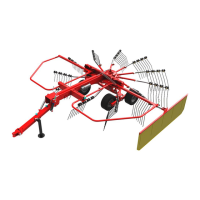


 To Next Page