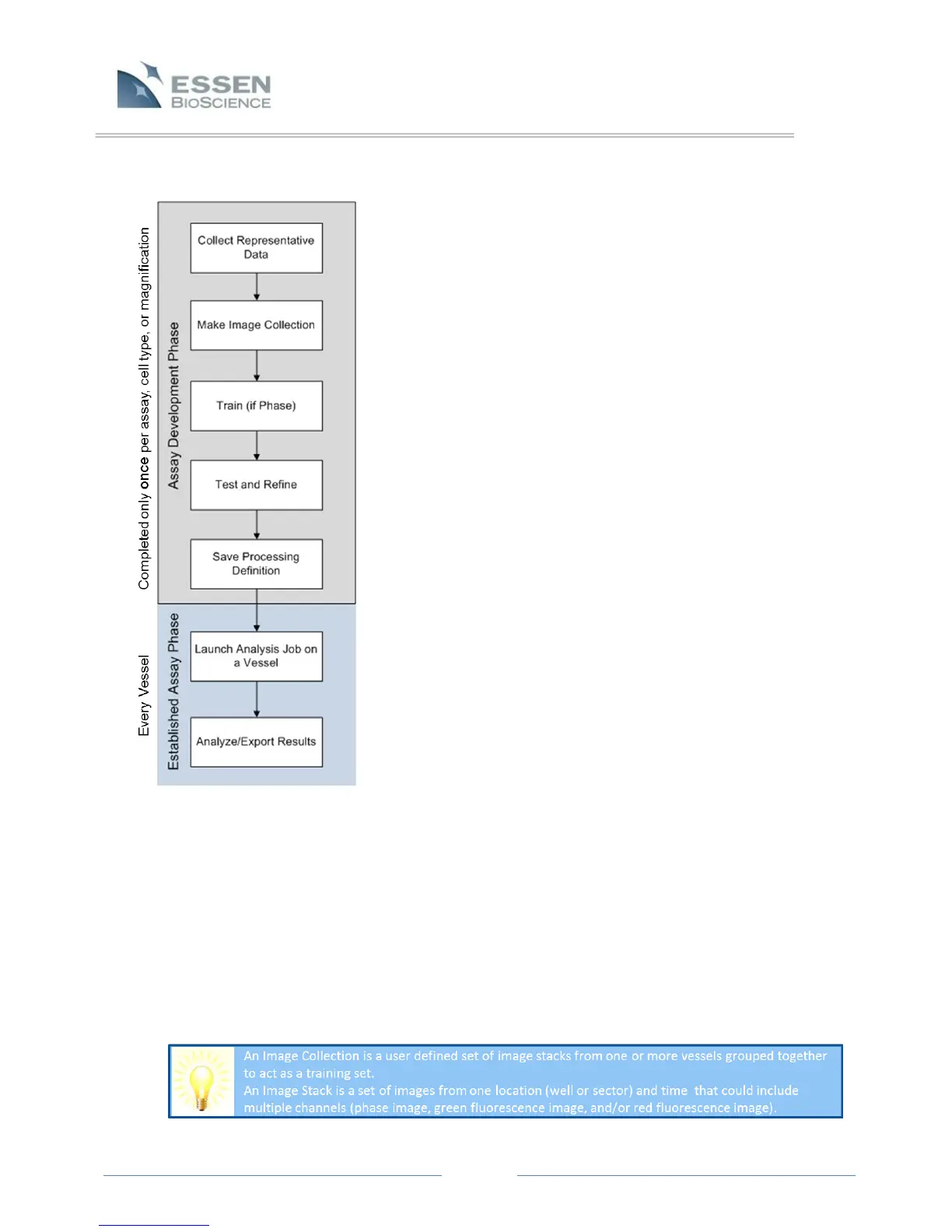
for their vessel. This task can be completed by using the Analysis Job Utilities found in the
collection.
7.5.1.1 Assay Development Phase: In this phase, the User
defines the image analysis parameters that will be used to analyze
all images within an established assay. These parameters will be
applied to all current and future experiments/vessels that use the
same experimental conditions (Assay/Cell Type/Objective). Future
experiments will skip the Assay Development Phase.
1. The first step in Assay Development Phase is to collect
representative images that form a data set called an Image
Collection. For example, if a User wants to monitor cell
confluence over time, the User would collect phase
contrast images of cells every 3-6 hours as they proliferate
over the course of 3-5 days.
2. This image collection is then used to train (phase) and test
(phase and/or fluorescence) a Processing Definition. It is
within this Processing Definition that Users set the
parameters that will be applied to all images within current
and future data.
3. Once the Processing Definition is established, it should not
need to be created again. The tested, finalized and saved
Processing Definition is then used in the Established Assay
Phase.
7.5.1.2 Established Assay Phase: Once the parameters are
defined in the Assay Development Phase, Users can apply those
parameters to all current and future experiments at the time of
assay initiation (scheduling).



 To Next Page