34000 Autry Street, Livonia, MI 48150 • 800.968.5530 • Fax 734.419.0209 • www.hamiltonengineering.com • LIT91127 REV 3/09
Page 25 of 50
PART 7. SERVICING
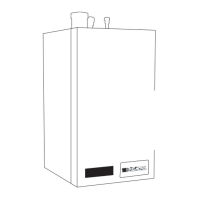
A. SERVICING THE EVO
1. Shut off the power supply to the appliance (See Figure 1-4, Page 7).
2. Remove the front cover security screw(s).
3. Undo the two latches at the bottom of the cover (if applicable).
4. Remove the cover.
B. PLACING THE EVO INTO NORMAL OPERATION
1. Replace the front cover in the normal position.
2. Close the latches on the bottom of the cabinet (if applicable).
3. Replace the security screw(s).
4. Turn on the power supply to the appliance.
SERVICING
3. The control then performs selected system diagnostic checks. If all checks are successfully
passed, a pre-purge cycle is initiated (the blower will be on maximum speed).
4. When the pre-purge period is complete, power is applied to the spark ignitor for 4.5 seconds.
Approximately 1/2 second later, ame is veried. If a ame is not veried during the trial-for-
ignition, the gas valve is immediately closed and the control will return to Step 3. After four trials,
if a ame is not veried, the control will go into a lockout mode. If a ame is conrmed, the
control enters the heating mode. The ring rate will be based on the control’s proprietary algorithm.
5. When water temperature reaches the temperature set point value, the burner will be at
minimum ring rate. If, when ring at minimum rate, it reaches 3°F over temperature setpoint,
the gas valve closes and the control enters a post-purge state (the blower will be on maximum
speed). At any time if an external thermostat is being used and becomes satised, the gas valve
will be closed immediately and display will read “0”.
6. When the post-purge is complete, the control enters an idle state while continuing to monitor
temperature and the state of other system devices. If a call-for-heat is received, the control will
automatically return to Step 2 in sequence and repeat the entire operating cycle.
7. Built in freeze protection: all models will automatically turn the pump on if the heat exchanger
reaches 41°F and the burner if it reaches 37°F, it will turn off at 50°F.
Note: power must be left on for this protection to function.
During the idle state and heat state, if the control detects an improper operating state from external
devices, such as the high-limit switch, the control will illuminate an error code in the display.


 To Next Page