Need help?
Do you have a question about the Fibocom FM101-GL and is the answer not in the manual?
Provides a general introduction to the FM101 hardware and its purpose.
Lists the industry standards the product design complies with.
References other documents relevant to the FM101 module.
Introduces the FM101 as an integrated 4G WWAN module with M.2 interface.
Details the technical specifications, including RF characteristics and data throughput.
Highlights the main features of the FM101 module, such as CPU, memory, and OS support.
Illustrates the peripheral applications and connections for the FM101 module.
Presents the main hardware functions of the FM101 module, covering baseband and RF.
Details the antenna configuration and supported bands for the FM101 module.
Describes the standard M.2 Key-B interface, including pin map and definitions.
Covers the power supply interface, voltage ratings, and power consumption of the module.
Explains control signals for module power on/off, reset, and start-up/shutdown sequences.
Details the USIM interface, pins, circuits, hot-plug function, and design considerations.
Covers USB 2.0 and USB 3.0 support, interface definitions, and application circuits.
Describes the LED#1 signal used to indicate module operating status.
Explains interrupt signals like W_DISABLE1# and DPR for module control.
Details ANT tunable interfaces for antenna configuration and control.
Explains the configuration pins used to determine the module type in the M.2 slot.
Covers RF interface functionality, connector characteristics, dimensions, and assembly.
Lists the operating bands, modes, and frequency ranges supported by the FM101 module.
Details the transmitting power for each band and mode according to 3GPP requirements.
Provides receiver sensitivity data for dual antennas across various bands and modes.
Describes GNSS support, positioning systems, conditions, and test results.
Outlines antenna requirements, including bandwidth, impedance, and standing wave ratio.
Details ESD handling precautions and ESD characteristics for different interfaces.
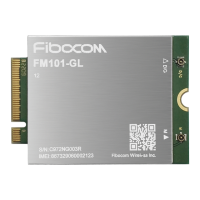
Shows the physical appearance of the FM101 module.
Provides the structural dimensions and drawings of the FM101 module.
Specifies the M.2 interface model, dimensions, and type for the FM101 module.
Recommends specific part numbers and shows dimensions for M.2 connectors.
Explains M.2 card insertion and assembly methods for single-sided modules.
Covers storage conditions, life, packaging methods, and tray dimensions for the module.
Critical notices for OEM integrators regarding installation, testing, and compliance.
Specifies the FCC/IC ID labeling requirements for the final product.
Guidance for OEM integrators on end-user manual content regarding the RF module.
Details compliance with FCC Part 15 rules and measures for interference.
Lists FCC rules and requirements relevant to modular approval and host product compliance.
Specifies FCC and IC radiation exposure limits and installation distance requirements.
Defines conditions for module use by OEM integrators, including antenna placement and co-location.
Details compliance with Industry Canada's licence-exempt RSSs and operating conditions.
Defines conditions for module use by OEM integrators in Canada, including antenna gain adjustment.
 General
| Manufacturer | Fibocom |
|---|---|
| Model | FM101-GL |
| Form Factor | LGA |
| Operating Temperature | -40°C to +85°C |
| Power Consumption | TBD |
| GSM Bands | 850/900/1800/1900 MHz |
| SIM Interface | 1.8V/3V |
| Antenna Interface | Main, Diversity, GNSS |
| Module Type | LTE Cat 1 / Cat M1 / NB2 |
| LTE Bands | B1/B2/B3/B4/B5/B8/B12/B13/B18/B19/B20/B25/B26/B28/B66 |
| GNSS | GPS/GLONASS/BeiDou |
| Data Rate (LTE Cat 1) | 10 Mbps downlink, 5 Mbps uplink |
| Data Rate (EGPRS) | DL: 296 kbps, UL: 236.8 kbps |
| Data Rate (GPRS) | Max 85.6 kbps |
| Interface | USB 2.0 |
| Certifications | CE, FCC, IC |
| Firmware Update | FOTA |
| Operating System Support | Linux, Windows |
| Power Supply Voltage | 3.3V |

 To Next Page