Installation Instructions
Seite/Page 68 - Kaptitel/Chapter 5: Installation Instructions 15.2.13
As it consistently happens that functioning risks are not realised during the laying of the exhaust hose, the following
explanations refer explicitly to the exhaust hose. Here, the location, the size and the position of the „waterlock“ play
a very decisive role:
5.8.2 Installation area of the waterlock
Concerning a water-cooled exhaust system, it must be regarded that - under no circumstances - cooling water from
the exhaust hose can get into the exhaust elbow area at the engine. If this happens, the cooling water can get into
the combustion chamber via an open discharge valve. This would lead to irreparable damage at the engine.
In addition to that, one has to reckon with possible tilted positions of sailing yachts, which makes the position of the
waterlock even more important. In general one could say that:
The deeper the waterlock is located underneath the generator, the better the protection from entering water into the
combustion chamber.
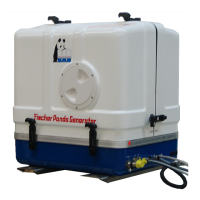
The picture below shows that the distance between the critical point at the exhaust elbow and the maximum permis-
sible water level in the exhaust hose is stated with 600 mm. This distance should be understood as a minimum dis-
tance.
Fig. 5.8.2-1: Installation area of the waterlock
5.8.3 The volume of the waterlock
The waterlock must be measured so large, that it can take the entire amount of water flowing back from the exhaust
hose. The amount of water depends on the hoses’ length (L) and its cross section. While the diesel engine is run-
ning, cooling water is continuously injected into the exhaust system and is carted outside with the emissions by the
exhaust gas pressure. When the engine is turned off, the number of revolutions sinks quite fast. By doing so, the
point is reached where the exhaust gas pressure does not suffice anymore to cart the cooling water out. All cooling
water remaining in the hose at that point flows back into the waterlock. At the same time, the diesel engine itself con-



 To Next Page