Age degradation
Tires degrade over time due to the effects of
ultraviolet light, extreme temperatures, high
loads, and environmental conditions. It is
recommended that tires are replaced every
six years, but may require replacement
more frequently.
TIRE WEAR
WARNING: The tire wear indicators
show the minimum tread depth
recommended by the tire manufacturer.
Tires which have worn to this point will have
reduced grip and poor water displacement
characteristics.
The tires fitted to your Karma are moulded
with a high grip compound and reduced
tread depth to emphasise dry road traction
and handling. The focus on dry road
traction produces a tire that will not last as
long as a general purpose tire. Drivers
should expect significantly shorter tire life
with these tires.
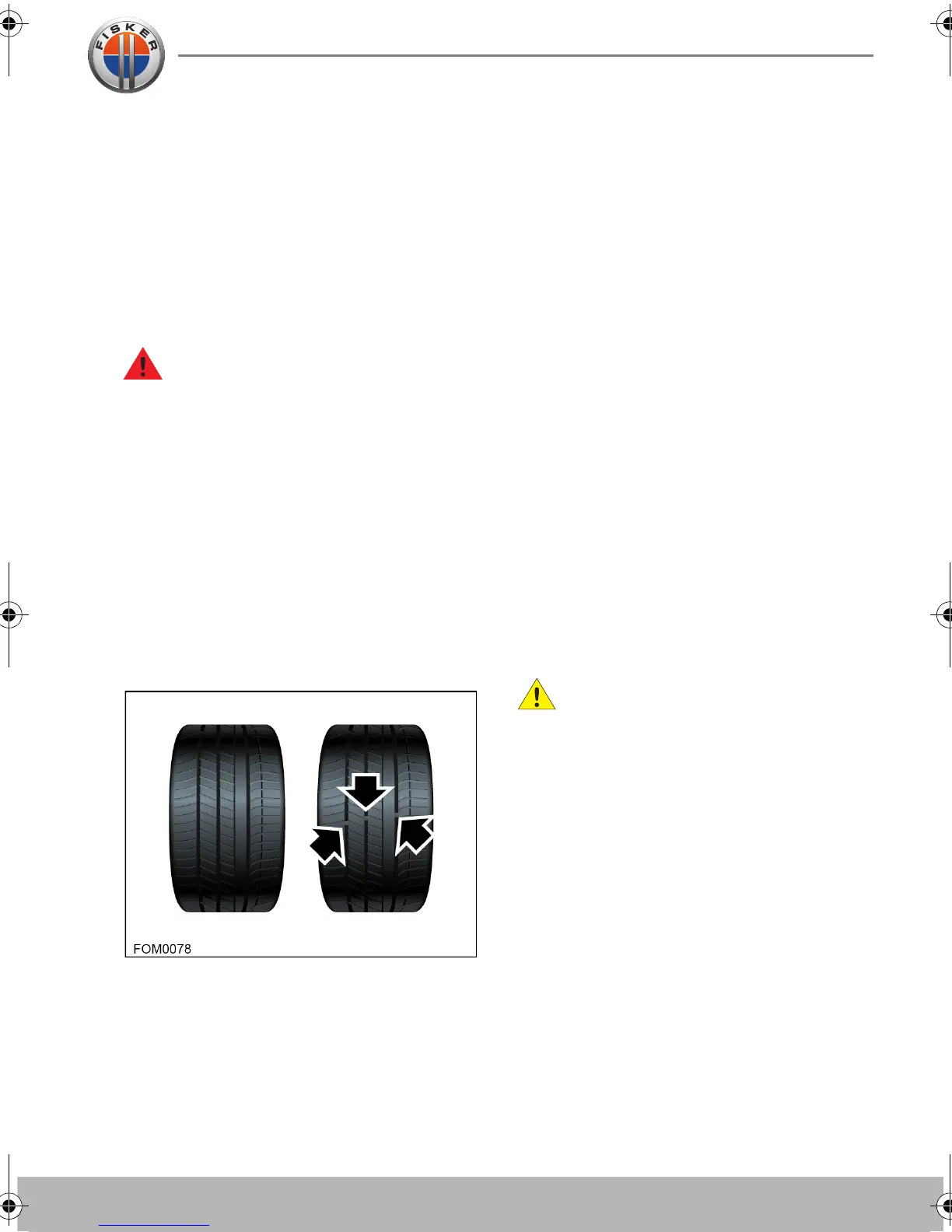
Tires fitted as original equipment have wear
indicators moulded into the tread pattern.
As the tire tread wears down the indicators
start appearing at the surface of the tread,
producing the effect of a continuous band
of rubber across the width of the tire.
A tire must be replaced as soon as an
indicator band becomes visible or the tread
depth reaches the minimum permitted by
legislation.
Normal tire wear
The characteristics for normal tire wear on
the Karma are defined as:
• A uniform thickness of usable rubber
across the entire tread width of the tire.
• The tread depth at the shoulder ‘rib’ is
reduced compared to the center of the
tire. This helps the Karma achieve
excellent steering and dry road handling
performance.
• Under typical operating conditions, the
shoulder rib may appear to be wearing
at an accelerated rate. Depending on
driving style, this may apply more to the
front tires than the rear tires.
Note: Shoulder ribs will still have usable
tread rubber, even though they appear
worn.
CAUTION: Karma tires are classified
as a ‘summer’ tire and use a softer
rubber compound for driving conditions
above 50°F (10°C). Hard cornering and
large steering angle manoeuvres will
accelerate shoulder wear.
Owner's Handbook - US English.book Page 3 Friday, June 22, 2012 11:28 AM



 To Next Page