70
This preserves your braking power. The
only exception is if you are cycling in
slippery conditions such as on sand or
asmooth surface.You shouldthenex
-
ercise great care, slowing yourself down
using the rear brake. Otherwise there is
the risk of the front wheel slipping out to
the side and causing a fall. Take regular
breaks during long downhill sections to
give the brakes sucient time to cool
down.
Do not touch the brakes for at least 30
minutes after riding as they can become
very hot.
Almost all modern brakes provide con-
siderably more braking power than was
available for bicycles in the past. Care
-
fully familiarise yourself with the brakes,
practising using them and practise
emergency braking, starting on safe
groundwithnotracbeforesettingout
intothetrac.
Look ahead while riding. Only use origi
-
nal spare parts. Otherwise it is possible
that the functionality of your FLYER
e-bike may be impacted or damaged.
Adjust the brake lever to ensure that it
does not touch the handlebars when
pulled hard.
17.2 Disc brake
Disc brakes must be installed and ser-
viced by a FLYER specialist retailer.
Incorrectly set-up brakes can cause ac
-
cidents and serious injuries.
A brake test is required before each ride and particu
-
larly after each brake adjustment.
Brakingbehaviourmayvary,inparticularafterex
-
changing the brake pads.
®
Disc brakes require a bedding-in time to wear in
the discs and pads. The braking system only de
-
livers its full performance after around 10 braking
cycles from 30 km/h. The braking force increases
during this time. Consider this during the entire
duration of the wearing-in period.
This wearing-in period is also required after re
-
placing the brake pads or discs.
Pay attention to any unusual noise when braking,
as this could be a sign that the brake pads have
worn down to the wear limit. Check the thickness
of the brake pads once the brakes have cooled
down.
If necessary, have the brake pads replaced.
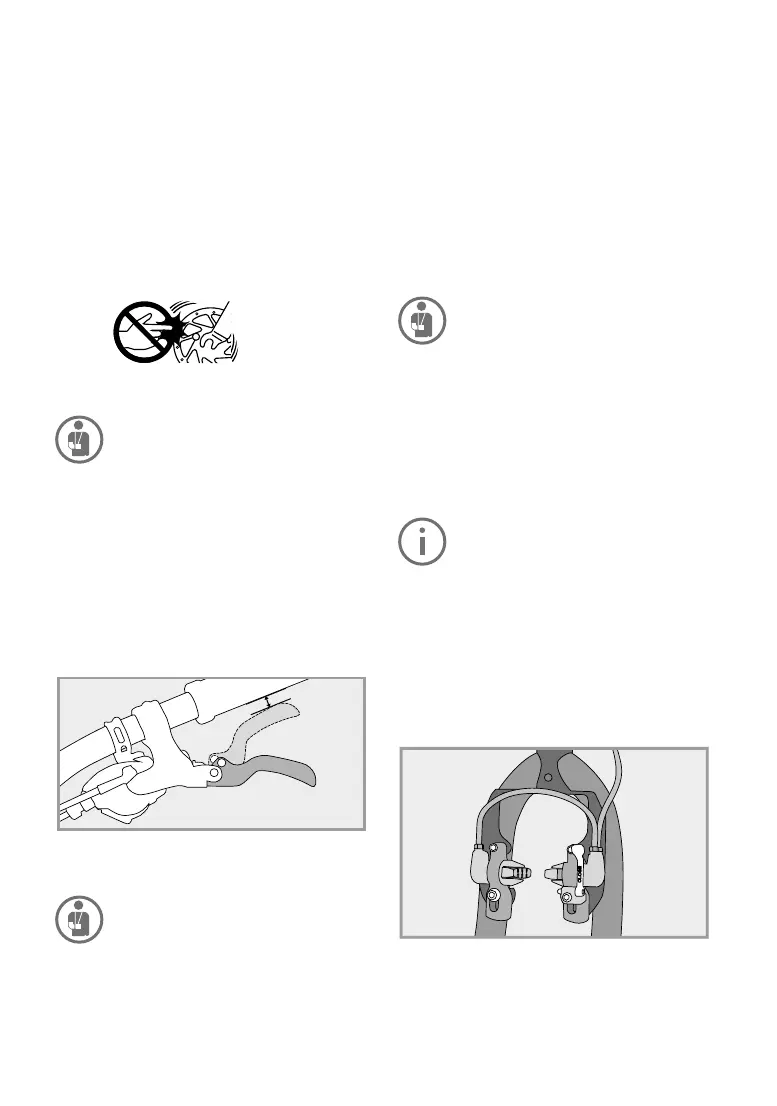
Please do not touch the brake disc while
itisrotating.Youcansuerseriousinju
-
riesifyourngeriscaughtinthegapsof
a rotating brake disc.
The brake calliper and disc may get hot
during braking.
Youcouldsuerburnsifyoutouchthis
part during or directly after braking.
Have the brake disc replaced if it is worn out or
bent. This replacement procedure must be car
-
ried out by a FLYER specialist retailer.
Air bubbles in disc brakes
You can avoid this problem by applying
the brake lever before transport and then
xing it in this position using a strap.
This prevents any air from entering the
hydraulic system. Please note that the
brake lever may not be pulled when the
wheel has been removed. Place a spac
-
er between the brake blocks if you need
to remove the wheel.
17.3 Hydraulicrimbrakes
As the brake pads wear, the path of the hand
lever increases. When this happens, you may
have to adjust the rim brakes. As is the case for
most bike models, this can be done by adjusting
a screw or a setting wheel on the brake lever. Ask
your FLYER specialist retailer for details.


 To Next Page