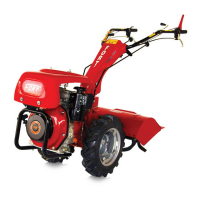
38
4.4.2 PARKING
WARNING
Do not park the machine near yielding grounds, near
slopes, ditches or steep grounds.
Never let the machine unattended when stopped.
On request, the motor cultivator may be equipped
with drum brakes on the two wheels with independ-
ent controls on the handlebars.
By pulling the brakes control levers to the stop, that
is towards the operators, these are kept locked; this
helps a safety parking of the machine.
4.5 DIFFERENTIAL LOCKING
We suggest to lock the differential when you are work-
ing on slippery ground, when either wheel skids or
when you intend to move always in the same direction.
The differential locking is obtained by pulling the lever
back towards the operator (15 Fig. 1) in the «LOCKED»
position, after reducing the engine r.p.m. and after
engaging the clutch.
For the re-start, after entering the differential lock,
very slowly lower the control clutch lever (16, Fig. 1)
after pressing the lock lever (17, Fig. 1).
N.B. To avoid possible damage to the gears of the
machine, it is advisable to operate the differential
lock only after releasing the control clutch lever.
This is for the insertion and for the disengagement.
- Do not lock the differential before turning or when
the 3 or 4 gear is engaged. Before turning, always
disconnect the differential locking, putting the lever
(14 Fig. 1) back to the «UNLOCKED» position.
4.6 POWER TAKEOFF
It works independently from the gearbox with the
machine either moving or stopped.
With the engine at 3600 rpm, are obtained: 965 rpm
and direction of rotation: clockwise in the mover
model and counterclockwise in version cutter (making
reference to the grooved bush).
Engagement and disengagement
In order to engage the power takeoff, carry out the
following operations:
- With clutch lever free and the machine stopped
bring the engine in an idle position by turning the
taccelerator lever (8, Fig. 1).
- Pull or push the control PTO rod (13, Fig. 1) accor-
ding to the position in which it is;
- Lower slowly the control clutch lever, after turning
off its locking system;
- Accelerate gradually to the desired rpm.
WARNING
In the cutter unit model (Fig. 1) the machine is
equipped with a special safety device that automati-
cally stops the PTO rotation when reverse speed is
engaged. In this way, the cutter unit does not rotate
and there is no danger for the operator.
WARNING
The motor hoe with cutter bar works in the best way
when the peak r.p.m. of the motor are 1700/2200
(corresponding to 1/4 - 1/3 of the throttle lever). At
this speed there is the best ratio of motor rpm to
strokes of the knife.
4.7 STOPPING THE ENGINE
The engine must be stopped on the level ground
and not on the soft ground, near drop-offs, ditches
or slopes.
To stop the machine for engines with recoil starter,
operate in the following way:
- Set the accelerator lever to the idle position.
- Release the control clutch lever (16, Fig. 1) and put
the gear in a neutral position.
- Lock safely the machine to prevent itsaccidental
movement.
- Turn the red lever for engine shutdown (8, Fig. 1)
to “O”.
4.7.1 ENGINE STOP FOR MACHINES
EQUIPPED WITH ELECTRIC STARTER
To stop the machine, act as follows:
- Bring the accelerator lever to idle.
- Release the control clutch lever (16, Fig. 1) and put
the gear in a neutral position.
- Lock safely the machine to prevent its accidental
movement.
- Turn the red lever for engine shutdown (8 Fig. 1)
to “O”.
- Rotate the starting key anticlockwise and return it
to the vertical position (the battery charger and the
engine oil pilot lights must be off).
- Remove the key from the control board and put
the rubber cap on it that prevents it from rotating
ENGLISH


 To Next Page