a station attendant or activate the service
station emergency shut-off switch to cease the
flow of CNG.
9.
Switch on the service pump. A slight hissing
noise may be heard as the fuel cylinders fill.
10.
Watch the pressure gauge on the service pump.
When the gauge reads approximately 3600 psi
(24 800 kPa), or when the fill pressure stops
climbing, the CNG cylinders are full. The service
pump will shut itself down automatically. See
Table 19.1 for pressure compensation values
based on ambient temperatures.
11.
Move the selector knob on the service pump to
the VENT position, if equipped. A short hiss will
be heard as a small amount of natural gas is
vented into the hose.
WARNING
Do not attempt to remove the fill station nozzle
from the tank fill fitting until venting of pressure
is noted. If no venting occurs, ask for assistance
from the station attendant. Removing an
unvented coupling could result in an
uncontrolled hose, which could lead to property
damage or personal injury.
12.
Remove the station dispensing nozzle from the
vehicle fill port.
13.
Install the dust cap on the vehicle fuel fill port
and close the fuel panel access door.
LNG Vehicle Fueling
The LNG fuel tank is designed to be filled from any
LNG fuel source that has a 100 micron or finer fuel
filter and a fuel delivery pressure between 120 and
225 psi (827 and 1551 kPa).
The LNG fuel tank is designed to be top-filled
through a single hose with no vent return. As cold
LNG is sprayed into the vapor space of the tank, the
cold liquid condenses the vapor and creates space
for itself inside the tank, eliminating any need to vent
during the filling process.
The LNG tank is equipped with a small internal
ullage tank for vapor space, which allows for fuel
expansion and increases vehicle standby time. When
an LNG tank is full, fuel can continue to flow into the
ullage tank. However, if the ullage tank is completely
filled during fueling, standby time will be reduced to
zero and the primary relief valve will open almost
immediately after fueling, allowing excess LNG vapor
to escape. If fueling is stopped when the ullage tank
is empty (i.e., the fuel tank has sufficient vapor space
to accommodate fuel expansion due to temperature
increase), the vehicle will have approximately one
week of standby time before venting will occur.
Use the following steps to fuel an LNG vehicle.
1.
Shut down the engine and apply the parking
brake.
IMPORTANT: Close all windows and doors
during the fueling process. Keeping windows
and doors closed allows for easier leak
detection inside the cab after fueling.
WARNING
Liquefied natural gas is a cryogenic liquid stored
at approximately -259°F (-162°C). Cryogenic
burns can be caused by coming into contact with
the pressurized liquid stream, or by coming into
contact with fuel system components that have
been cooled to cryogenic temperatures. Always
wear gloves and a face shield, and cover
exposed skin when fueling.
2.
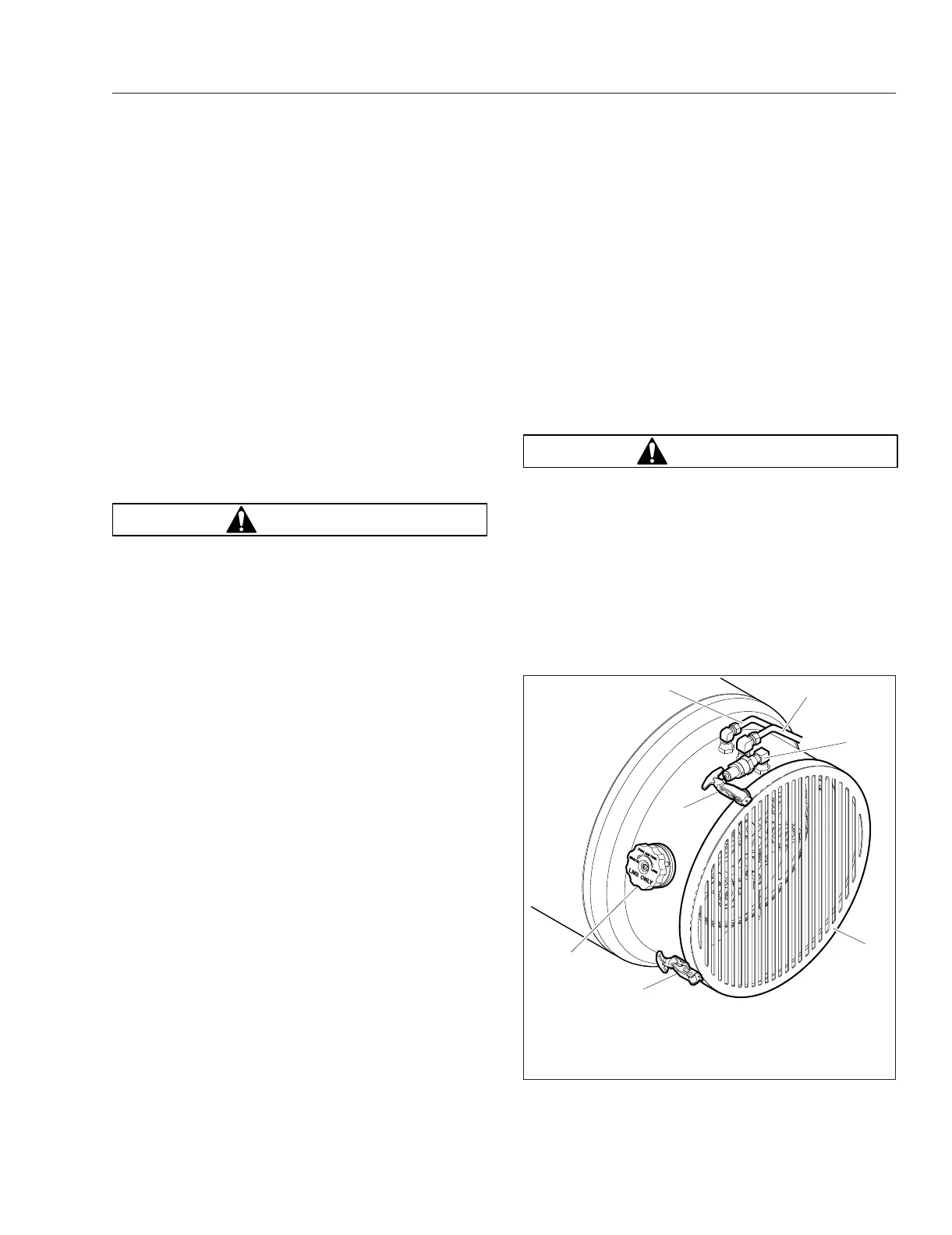
Remove the fuel fill fitting dust cap. See
Fig. 19.3.
05/29/2009 f470534
1
2
3
4
6
5
6
1. Fuel Fill Fitting
2. Fuel Outlet Line
3. Primary Relief Vent
Line
4. Fill Vent Fitting
5. Shroud Cover
6. Shroud Cover Latches
Fig. 19.3, LNG Fuel Tank
Natural Gas Vehicle Information
19.4




 To Next Page