
 Need help?
Do you have a question about the Froling PECO and is the answer not in the manual?
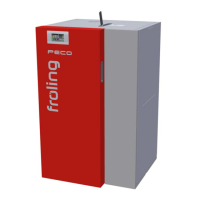
Information for the following sizes of PECO boilers: PECO 15, PECO 20, PECO 25, PECO 30, PECO 32, PECO 35.
Explains hazard levels used in documentation: DANGER, WARNING, CAUTION, NOTICE.
Assembly and installation must be carried out by qualified personnel: heating technician, electrical technician, Froling customer services.
Specifies required PPE for transport, erection, and installation: work wear, gloves, safety shoes.
Lists relevant standards for heating systems, structural/safety devices, heating water, and permitted fuels.
Boiler must be operated in a closed system. Requires official approval from supervisory/building authorities.
Requirements for load-bearing substrate and conditions at the installation site: frost-free, well-lit, free of explosive atmospheres.
Details requirements for flue gas system, connection line, measuring port, draught limiter, explosion flap, and particle separator.
Details requirements for combustion air supply from the installation room, including opening to atmosphere and air supply lines.
Defines terms for room air-independent operation (Type C42, C82, FC42x, FC52x) and requirements for supply air line.
Covers standards and recommendations for domestic hot water systems, including water quality and permitted hardness.
Explains compressor-controlled and pump-controlled pressure maintenance systems for hot-water heating.
Recommends using a storage tank for continuous fuel supply and ideal output range.
Details fitting automatic ventilating valves and microbubble separators for proper boiler ventilation.
Provides detailed dimensions for PECO boilers (15-20 and 25-35) including length, width, height, and connection points.
Illustrates and lists all boiler connections: flow, return, drainage, supply air, flue pipe, pellet suction, and return-air.
Lists technical data for PECO 15-20 models, including output, weight, capacity, and regulations compliance.
Provides boiler data for flue gas system planning: temperature, CO2, mass flow, feed pressure, and pipe diameter.
Details dimensions and connections for the external suction module used for pellet loading.
Lists components included with the boiler: PECO unit, suction module, protective plate, hose clamps, and accessories.
Lists necessary tools for assembling the boiler and suction module, including wrenches, screwdrivers, and drills.
Provides notice on handling the product during transport to avoid damage, emphasizing care and protection against damp.
Explains how to position the boiler using a fork-lift or similar lifting device.
Provides guidance on storing components in a protected, dry location, away from dust, damp, and frost.
Covers moving the boiler into the room and establishing operating and maintenance areas with specified clearances.
Details the process of removing the boiler from the pallet and initial installation steps.
Outlines preparations for lifting and transporting boiler type 25-35, including door and cover removal.
Explains how to level the boiler using adjustable feet to avoid structure-borne sound transmission.
Details steps to prepare the boiler for room air-independent operation by modifying the supply air connection.
Describes how to bend and install the protective plate to shield boiler components from the flue gas pipe.
Instructs to attach the maintenance sticker legibly to the inside of the insulated door.
Covers connecting suction and return air lines to the boiler and external suction module.
Details installing the external suction module in the return-air line, including electrical connection and hose connection.
Explains how to dismantle cover plates and use hose clamps to secure suction hoses to the boiler connections.
Provides guidelines for routing hose lines, including bending radius, earthing, and sectioning.
Ensures consistent potential equalisation when connecting hose lines, including earth wire preparation and hose clamp attachment.
Details electrical connection procedures, safety precautions, and cable routing for components.
Outlines precautions for initial setup, emphasizing professional configuration and system checks.
Covers permitted fuels (wood pellets), non-permitted fuels, and the first heating-up procedure.
Provides measures for leaving the boiler out of service for extended periods, including cleaning and draining.
Instructs to disassemble the system by following the assembly steps in reverse order.
Guides on environmentally friendly disposal of the system in accordance with waste management regulations.

 To Next Page
 General