CHAPTER 2: INSTALLATION ELECTRICAL INSTALLATION
345 TRANSFORMER PROTECTION SYSTEM – INSTRUCTION MANUAL 2–23
Trip1 and Trip2 output relays
The 345 relay is equipped with seven electromechanical relays: two special relays
designed for Winding 1 Breaker trip and Winding 2 Breaker trip, four general purpose
relays (Auxiliary Relays 3 to 6), and a Critical Failure relay. The special purpose relays have
fixed operating characteristics and the general purpose relays can be configured by the
user.
Operation of the two Trip output relays is designed to be controlled by the state of the
circuit breaker as monitored by a 52a or 52b contact.
• The Trip relays reset after the breaker is detected in a state corresponding to the
command. When a relay feature sends a command to one of these special relays, it
will remain operational until the requested change of breaker state is confirmed by a
breaker auxiliary contact and the initiating condition has reset.
• If the initiating feature resets, but the breaker does not change state, the output relay
will be reset after a default interval of 2 seconds.
• If neither of the breaker auxiliary contacts, 52a nor 52b, is programmed to a contact
input, the Trip Relay is de-energized after either the delay programmed in the Breaker
Failure feature, or a default interval of 100 ms after the initiating input resets.
• If a delay is programmed for the Trip contact seal-in time, then this delay is added to
the reset time. Note that the default setting for the seal-in time is 40 ms.
Breaker monitoring (Trip coil monitoring) is performed by a built-in voltage monitor on
Form A output relays: #1 Trip, and #2 Trip. The voltage monitor is connected across each of
the two Form A contacts, and the relay effectively detects healthy current through the
circuit. In order to do this, an external jumper must be connected between terminals A2
and A3 for #1 Trip coil monitoring, or/and B4, and B5 for #2 Trip coil monitoring.
As long as the current through the Voltage Monitor is above the threshold of the trickle
currents (see Technical Specification for Form A output relays), the circuit integrity for the
Trip coil is effectively normal. If the Trip coil circuit gets disconnected, or if in general a high
resistance is detected in the circuitry, a Trip alarm will be set and the “ALARM” and
“MAINTENANCE” LEDs will be on.
Example 1: The figures below show the two different connections of the breaker Trip coil to
the relay’s trip output #1 terminals (output #2 Trip coil monitoring) for both no voltage
monitoring and voltage monitoring of the trip circuit integrity.
NOTE:
To monitor the Trip coil circuit integrity, use the relay terminals A2 and B3 to connect the
Trip coil, and provide a jumper between terminals A2 (optional voltage) and A3.
NOTE:
To monitor the Trip coil circuit integrity, use the relay terminals B4 and A4 to connect the
Trip coil, and provide a jumper between terminals B4 (optional voltage) and B5.
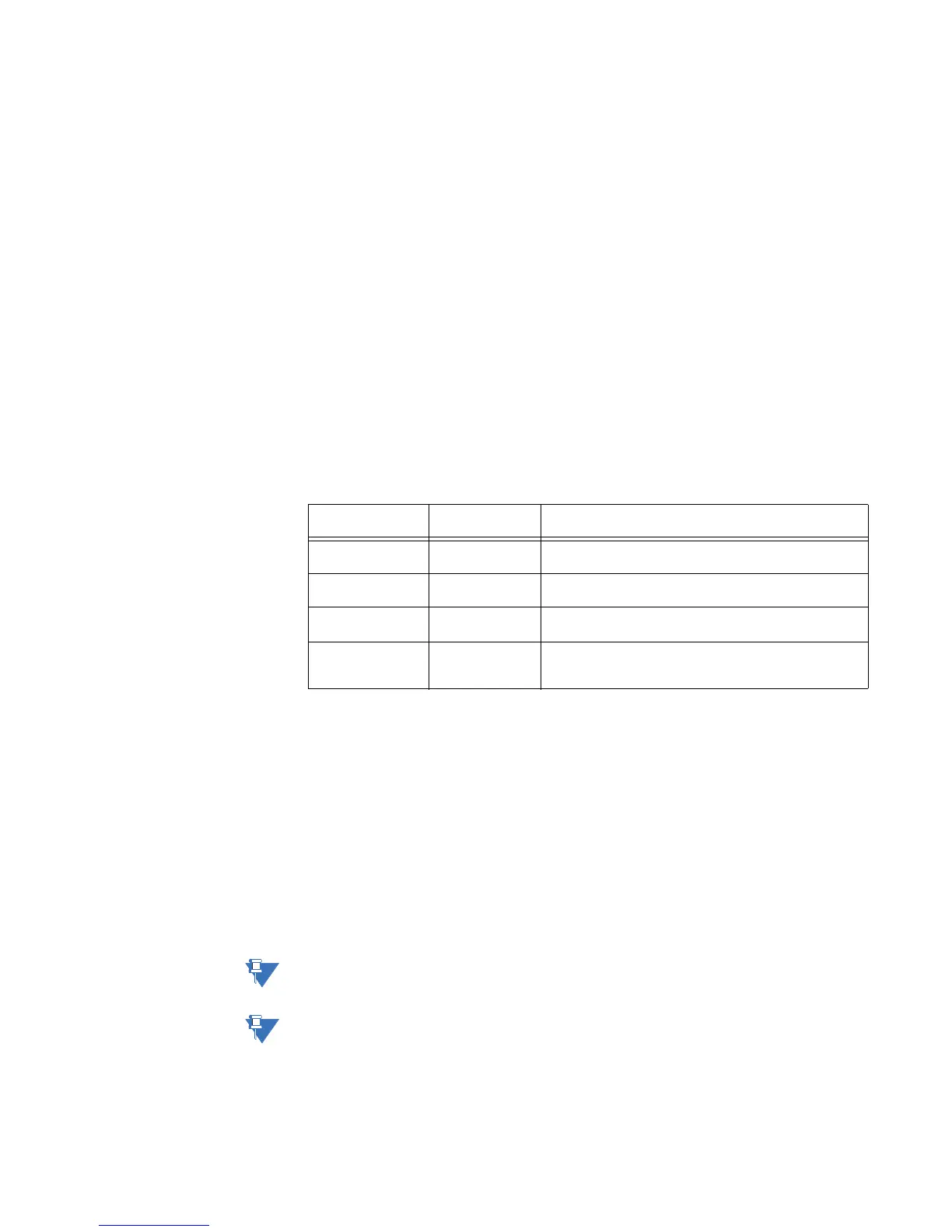
52a Contact
Configured
52b Contact
Configured
Relay Operation
Yes Yes Trip Relay remains operational until 52b indicates an
open breaker.
Yes No Trip Relay remains operational until 52a indicates an
open breaker.
No Yes Trip Relay remains operational until 52b indicates an
open breaker.
No No Trip Relay operates until either the Breaker Failure delay
expires (if the Breaker Failure element is enabled), or 100
ms after the feature causing the trip resets.


 To Next Page