
 Need help?
Do you have a question about the GEA VARIVENT Series and is the answer not in the manual?
Details document structure, binding character, illustrations, and symbols for clarity.
Provides the official contact address for GEA Tuchenhagen GmbH.
Lists phone, fax, and email for customer inquiries and support.
Confirms compliance with EU Machinery Directive 2006/42/EC.
Confirms compliance with Pressure Equipment Directive 2014/68/EU.
Specifies that the sampling valve type I is for drawing samples of liquids and viscous media.
Outlines prerequisites for safe operation: transport, storage, installation, and adherence to instructions.
Lists conditions under which the component's operational safety cannot be guaranteed.
Details the operating company's responsibility for safe handling and maintaining the component.
Advises against technical modifications and recommends using original spare parts.
Covers general safety principles and potential dangers from improper use or conditions.
Provides principles for safe valve operation, including instruction adherence and regular checks.
Outlines principles for environmental protection related to substance disposal and waste management.
Specifies safety principles for work on electrical equipment and control systems.
Lists additional regulations to be observed alongside the operating instructions.
Details training and qualification requirements for personnel working on the component.
Discusses safety equipment, focusing on warning, prohibition, and mandatory signs.
Explains the meaning of various signs (e.g., hazard, crushing, explosion) found on the valve.
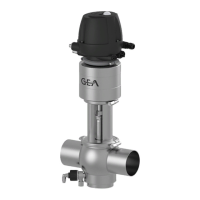
Illustrates and details the main components of the GEA VARIVENT sampling valve.
Details what to check upon receipt of the valve for completeness and good order.
Provides principles for safe and proper transportation of the valve units.
Specifies recommended conditions for storing valves, inserts, and spare parts.
Explains the information provided on the valve's type plate for identification.
Lists key technical specifications for the valve, including size and fitting position.
Provides technical data related to ambient temperatures and their effect on components.
Details specifications for the compressed air supply, including pressure and content.
Presents a table showing the resistance of sealing materials to various media.
Provides general measurement data for pipe ends in metric DN and inch sizes.
Lists recommended lubricants for the valve with their corresponding material numbers.
Details safety principles to avoid hazardous situations during installation.
Provides important notes regarding installation position and preventing system contamination.
Describes the procedure for fitting the valve using detachable pipe connection elements.
Details the welding procedure for the valve housing, including safety warnings.
Covers safety principles for initial commissioning and setting the valve into operation.
Lists important checks and actions to perform before and during commissioning.
Outlines safety principles for monitoring and operating the component safely.
Explains general cleaning requirements, safety data sheets, and cleaning agent considerations.
Provides examples of typical cleaning parameters for dairy operations and breweries.
Discusses factors affecting cleaning effectiveness like temperature, time, mechanics, and chemicals.
Describes the typical process of passivation using nitric acid for plants and tanks.
Details safety rules for maintenance and repair work, including isolation and protective measures.
Outlines safety principles for dismantling the component, emphasizing isolation and residual energy.
Describes checks to be performed between maintenance periods for seals and component function.
Explains how maintenance intervals are determined by operating conditions and product usage.
Provides guideline values for maintenance intervals based on media temperature.
Lists requirements and steps to follow before removing the valve for maintenance or replacement.
Step-by-step instructions for removing the valve disk from the valve assembly.
Step-by-step instructions for removing the handwheel from the valve.
Instructions for cleaning the valve, emphasizing safe detergents and part cleaning.
Guidance on replacing defective seals and using genuine O-rings for valve tightness.
Provides instructions for lubricating seals and threads, including grease type and application.
Instructions for installing the valve in reverse order of removal, with notes on O-rings and pistons.
Lists common malfunctions, their causes, and recommended remedies for the valve.
Details safety principles for shutting down the component, including power isolation.
Provides general notes on environmentally safe disposal of the component and its materials.
Details specific seal types, their quantities, materials, and part numbers for the sampling valve.
Provides a glossary of abbreviations and technical terms used in the document.
 General
| Series | VARIVENT |
|---|---|
| Actuation | Pneumatic |
| Connection Types | Clamp, weld end, threaded, flange |
| Application | Food, beverage, dairy, pharmaceutical, and chemical industries |
| Standards | EHEDG, FDA, 3-A |
| Materials | Stainless steel |





 To Next Page