5.1 INDIVIDUAL LIMITS OF OPERATION
With an operating compressor several working
conditions arise which one by one are bound to certain
limits. These so-called “individual operation limits” are
determined by structural limitations of the compressor
itself or they are based on thermodynamic and
practical considerations. They apply to both single-stage
and booster compressors.
When operating the compressor, none of the limits of
operation as stated in the table 5.1 below must be
exceeded.
Note:
In practice it is not so much the individual limits
of operation, described in this paragraph, as
combinations of them that are decisive for the
conditions under which a compressor may
operate. To check the various possibilities in this
respect, use should be made of the “fields of
application” according to the figures 5.1 to 5.5.
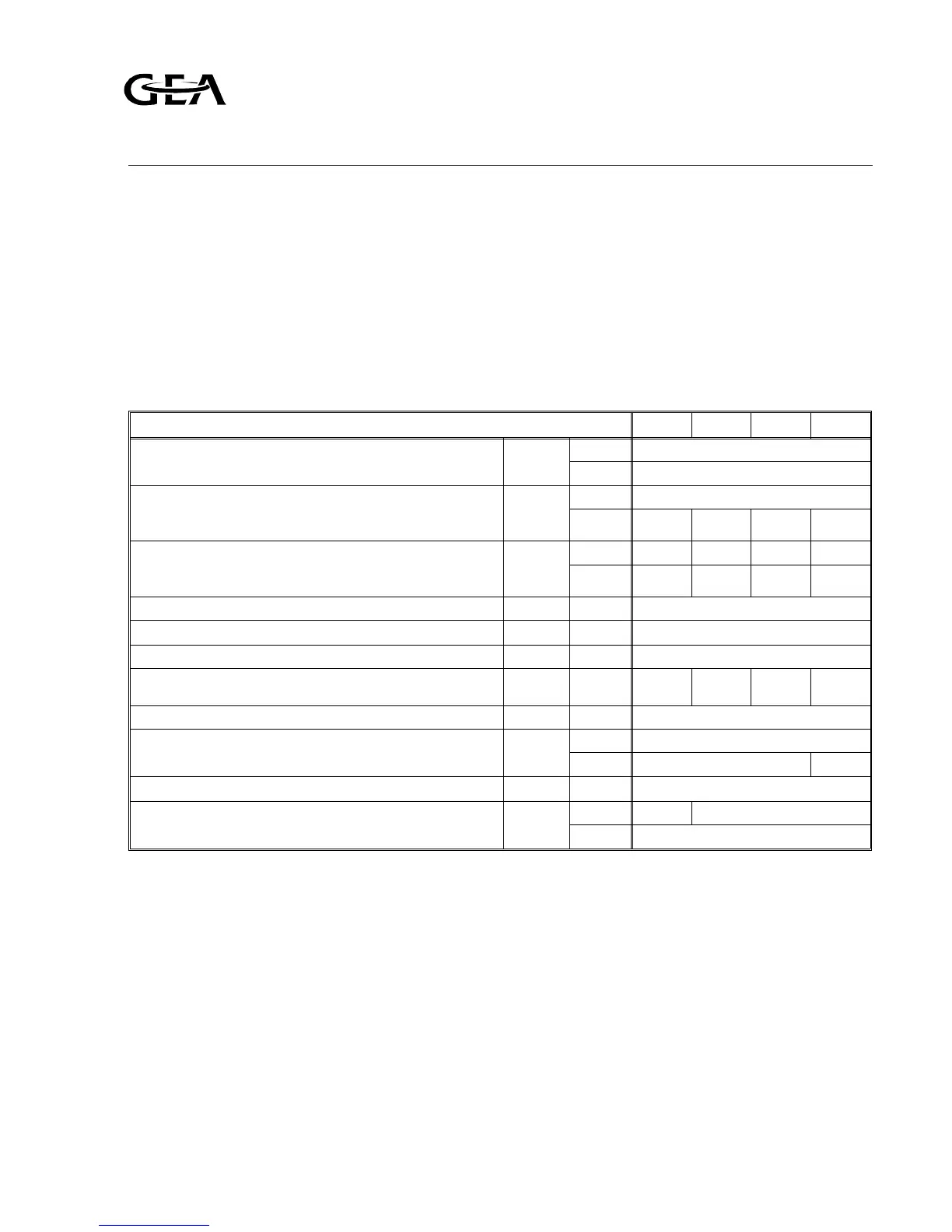
REFRIGERANT NH
3
R22 R134a R404A
Compressor speed n min
-1
min. 800
max. 1500
Suction pressure
= evaporating pressure
= crankcase pressure
1
)p
o
bar(a)*
min. 0.3
max. 6.2 6.8 6.2 6.0
Evaporating temperature
= saturation temperature
at suction pressure
1
)t
o
o
C
min. -55.1 -63.8 -50 -68.1
max. +10.2 +10.0 +22.6 -0.1
Actual suction temperature
2
)t
a
o
Cmin. -50
Suction superheat
∆t
o
Kmin. 5
Discharge pressure = condensing pressure
3
)p
c
bar(a)* max. 26
Condensing temperature
= saturation temperature at discharge pressure
t
c
o
C max. +59.8 +63.2 +79.5 +55.6
Discharge temperature
4
)t
e
o
Cmax. +155
Pressure ratio (p
c
/p
o
)
5
)j -
min. 1.5
max. 10 15
Pressure difference (p
c
-p
o
)
6
)
∆p
bar* max. 24
Oil temperature in crankcase
7
)t
oil
o
C
min. +20 +30
max. refer to pragraph 4.3
Table 5.1
* 1 bar = 10
5
N/m
2
= 100 kPa = 1.02 kgf/cm
2
= 14.5 psi.
1
) The minimum values of p
o
and t
o
are only of importance for
booster applications. In that case the maximum value of t
o
also
applies to the saturation intermediate temperature (t
m
).
For halocarbon refrigerants the maximum values of p
o
and t
o
are
based on a density of the suction gas of 30 kg/m
3
.
During start-up and immediately thereafter, p
o,max.
may be
exceeded slightly [up to 11 bar(a) max.] and temporarily, but no
longer than about 5 minutes.
The maximum static crankcase pressure during compressor
standstill is 21.5 bar(a).
2
) Only of importance for booster application.
3
) This pressure is also the maximum allowable pre-set value of the HP
safety switch.
4
) This is the actual discharge temperature, measured directly in the
gas flow inside the cylinder head covers, just above the discharge
valves.
5
) Pressure ratio limits are not absolute but arbitrary values based on
practical considerations.
6
) The standard built-in overflow safety valve between suction and
discharge chamber in the compressor housing has been factory-set
to 24.5 (+10%) bar to prevent advanced opening during normal
operation at ∆p ≤ 24 bar.
7
) Indicated minimum value is the lowest oil temperature at which
compressors are allowed to be started.
The maximum oil temperature depends on the operating
conditions of the compressor, the oil type used and (for halocarbon
refrigerants only) the solvability of the refrigerant in the oil. A
minimum actual oil viscosity of 15 cSt is always required.
When using ammonia as refrigerant, the maximum oil temperature
will be exceeded only when a combination occurs of high ambient
temperature, high suction superheat and part-load operation. In
that case an oil cooler is required. A water-cooled oil cooler always
form part of the standard delivery of a RC6W-compressor.
Refrigeration Division
Grasso
5. LIMITS OF OPERATION AND
FIELDS OF APPLICATIONS
v001.99.01.en Installation and Maintenance Manual RC(U)6 page C3.1


 To Next Page