GRISWOLD PUMP COMPANY Installation Page 8
Installation, Operation and Maintenance Manual
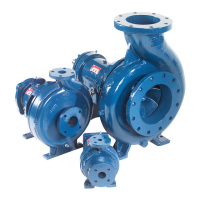
Griswold Model 811
Griswold Pump Company Installation Page 10
Suction and Discharge Piping
A complete instruction for piping design is beyond the scope of this manual. A comprehensive
guideline is available in the Hydraulic Institute Standards from The Hydraulic Institute,
9 Sylvan Way, Parsippany, NJ 07054, www.pumps.org. Note the following highlights:
In general, all piping must be supported independently of, and line up naturally with, the pump
flanges. Even a small amount of pipe strain, or flange loading, will cause misalignment of the
pump and motor shafts and cause vibration and premature wear. In cases of pumping at
elevated temperatures, pipe expansion must be accommodated with expansion loops or
expansion joints. These must be properly anchored to prevent pipe strain from being imposed on
the pump from both thermal expansion and hydraulic reactive loads.
With the initial installation of the pump system, all piping must be thoroughly cleaned and/or
flushed prior to pump start-up. Weld slag, rags, dirt and other debris can and will cause damage
to the pump.
Piping design should incorporate the ability to flush prior to the removal of pump components in
services where corrosive or otherwise harmful liquids are handled.
It is important to monitor the performance of a pump. So, in this regard, it’s recommended that
gauges be installed in the suction and discharge lines. Select the appropriate gauge range to
provide accurate readings. On pumps with suction lift, use a compound or vacuum gauge on the
suction side.
Suction Piping - General
Properly designed and installed suction piping is critical to the successful operation of a pump.
When pump operational problems are encountered, the causes are most often on the suction side.
To achieve proper pump performance, consider the following:
1. Avoid using elbows close to the pump suction flange as this can create an uneven flow into
the pump suction and impeller. If an elbow is necessary, it should be of the long radius type
and there should be a minimum of six pipe diameters of straight pipe between the elbow and
the pump suction nozzle.
2. The suction pipe should be at least one size larger than the pump suction size. This will
require an eccentric reducer to transition from the suction pipe to the pump suction flange.
The flat side of the eccentric reducer is at the top. This is to prevent air pockets in the suction
line.
3. If a strainer is used on the pump suction side, it must have a free area at least three (3) times
the area of the suction pipe. It must be checked and cleaned regularly as a clogged strainer
will reduce NPSH available and may cause cavitation.
4. Never throttle the suction side of the pump. This can cause cavitation and will likely damage
the pump.
5. When the suction supply source feeds more than one pump, separate suction lines are
recommended.


 To Next Page