2 Introduction
2.1 Description
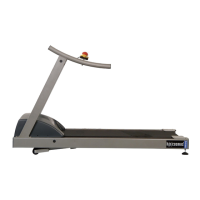
A running machine (also called “treadmill ergometer”) is an exercise device for running or walking while staying in one
place. The h/p/cosmos running machines are stationary treadmills which are used for training and testing, simulating
various adjustable speeds and various adjustable elevations (also called “slope” or “inclination”). The medical versions
can also be used for diagnostics and therapy applications. The machine provides a moving platform with a wide
conveyor belt and an electric motor. The belt moves to the rear allowing a person to walk or run an equal, and
necessarily opposite, velocity. The rate at which the belt moves is the rate of walking or running. Thus, the speed of
running may be controlled and measured.
The patient (for sports devices called “subject”) is asked to follow the speed of the belt and keep his position on the
deck. By walking and/or running, the physical condition of the patient can be analysed through a treadmill stress test
protocol and additional ECG or VO2max. (metabolic cart) diagnostic device. In physiotherapy and neurologic application
the patient can be additionally secured and un-weighted with a body weight support system and the gait can be
analysed and corrected under safe and reproducible conditions.
Duration of use of the medical versions is approx. 5 to 25 minutes per patient per day, depending on the prescription of
the doctor, the condition of the patient and depending on the standardized or individual load protocol (for example
BRUCE protocol).
The running surface areas range from 150 x 50 cm (59.0 x 19.7 inches) to 450 x 300 cm (177.2 x 118.1 inches).
Treadmills have handrails on both sides. Technical details are given in chapter 11 “Technical data” on page 160.
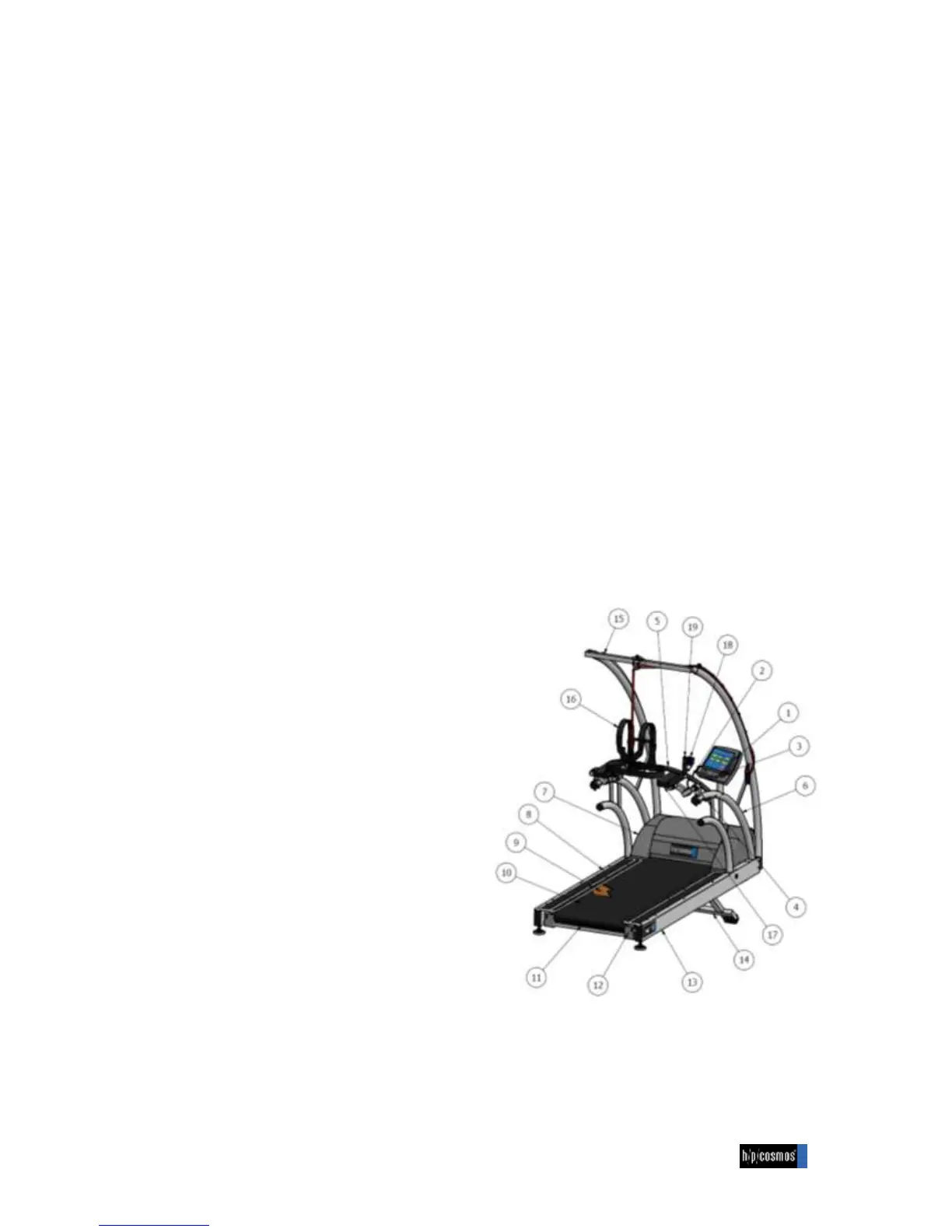
2.2 Device components, including software and accessories
[2] pull cord safety stop actuator
[3] emergency stop button (mushroom style)
[4] heart rate measurement system (receiver board)
the transmitter with chest belt * is an applied part
[5] handrail crossbar (front)
[6] handrails (side)
[7] motor hood/cover
[8] tread plate with slip resistant surface
[9] running surface (gliding plate/deck)
[10] running belt *
[11] rollers (behind the belt)
[12] roller cover
[13] base frame
[14] elevation element
[15] option/accessory: safety arch with fall-stop
prevention
[16] option/accessory: chest-belt/harness for safety arch
[17] option/accessory: arm support
[18] option/accessory: keyboard for arm support
[19] option/accessory: stop button for arm support


 To Next Page