20
8. Application
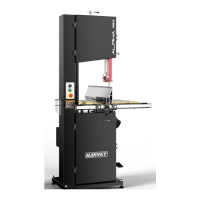
The following section contains basic information, and is not intended to cover all possible
applications or techniques using the band saw.
1. Make sure the blade is adjusted correctly for tension and tracking, and the upper and
lower blade guide are set in proper relation to the blade.
2. Adjust the guide post so that the blade guides are just above the workpiece allowing
minimum exposure to the blade.
3. If using the fence, move it into position and lock it to the guide rail. If you are using the
miter gauge for a crosscut, the fence should be moved safely out of the way.
4. Start the band saw and wait for the machine to reach full speed.
5. Use a push-stick, hold-down, power feeder, jig, or similar device while feeding stock, to
prevent your hands getting too close to the blade.
6. Place the straightest edge of the workpiece against the fence for a rip cut; or against the
miter gauge for a crosscut.
7. Push the workpiece slowly into the blade, while also keeping it pressed against the fence
or held against the miter gauge. Do not force the workpiece into the blade.
8.1 Ripping
Ripping is cutting lengthwise down the workpiece, and with the grain of wood stock. Always
use a push stick or similar device when ripping narrow pieces.
8.2 Crosscutting
Crosscutting is cutting across the grain of the workpiece, while using the m iter gauge to feed
the workpiece into the blade.
Do not use the fence in conjunction with the miter gauge. Using the fence in
conjunction with the miter gauge can cause binding and possible damage to the
blade and it can cause serious injury to the users.
8.3 Resawing
Resawing is the process of slicing stock to reduce its t hickness, or to produce boards that
are thinner than the original workpiece.
The ideal blade for resawing is the widest one the machine can handle, as the wider the
blade the better it can hold a straight line.
When using the resaw fence, use a push block, push stick, or similar device to keep your
hands away from the blade.


 To Next Page