Entering further basic program
30
Function AUX
The AUX relay output can be programmed for the following control
functions:
For example, it is possible to control the cooling water inlet of an
upstream cooler via a solenoid valve. This ensures that the cooling
water only flows when required, i.e. when an analysis is being carried
out.
– As a function output for the contact with programmable duration
prior to and/or during the analysis, or after an analysis.
In >BASIC PROGRAM, select
=> PROGRAM VALUES=> FUNCTION AUX
Select the program step at which the AUX contact is to be
activated
Under "Time" enter the contact duration in minutes (m) and
seconds (s)
Press "ENTER" to confirm the entry
Service II
The service II menu contains various functions for monitoring the
operation of the instrument:
Programming of the maintenance interval, operation (reset) internal
data/setting, e.g. water quantity and plant monitoring.
Use of the Service II menu
The functions in the Service II menu directly influence the operation
and monitoring functions of the instrument!
These tasks should only be carried out by trained and qualified
staff.
Reset operating time
After replacing a dosing pump or the measuring chamber holder, it is
possible to reset the current operating time to 0 hours.
In >BASIC PROGRAM, select
=> SERVICE II=> RESET OPERATING TIME
Select "Reset" to reset the operating time
Press "ENTER" to confirm the selection
The operating time "000000h" appears on the display
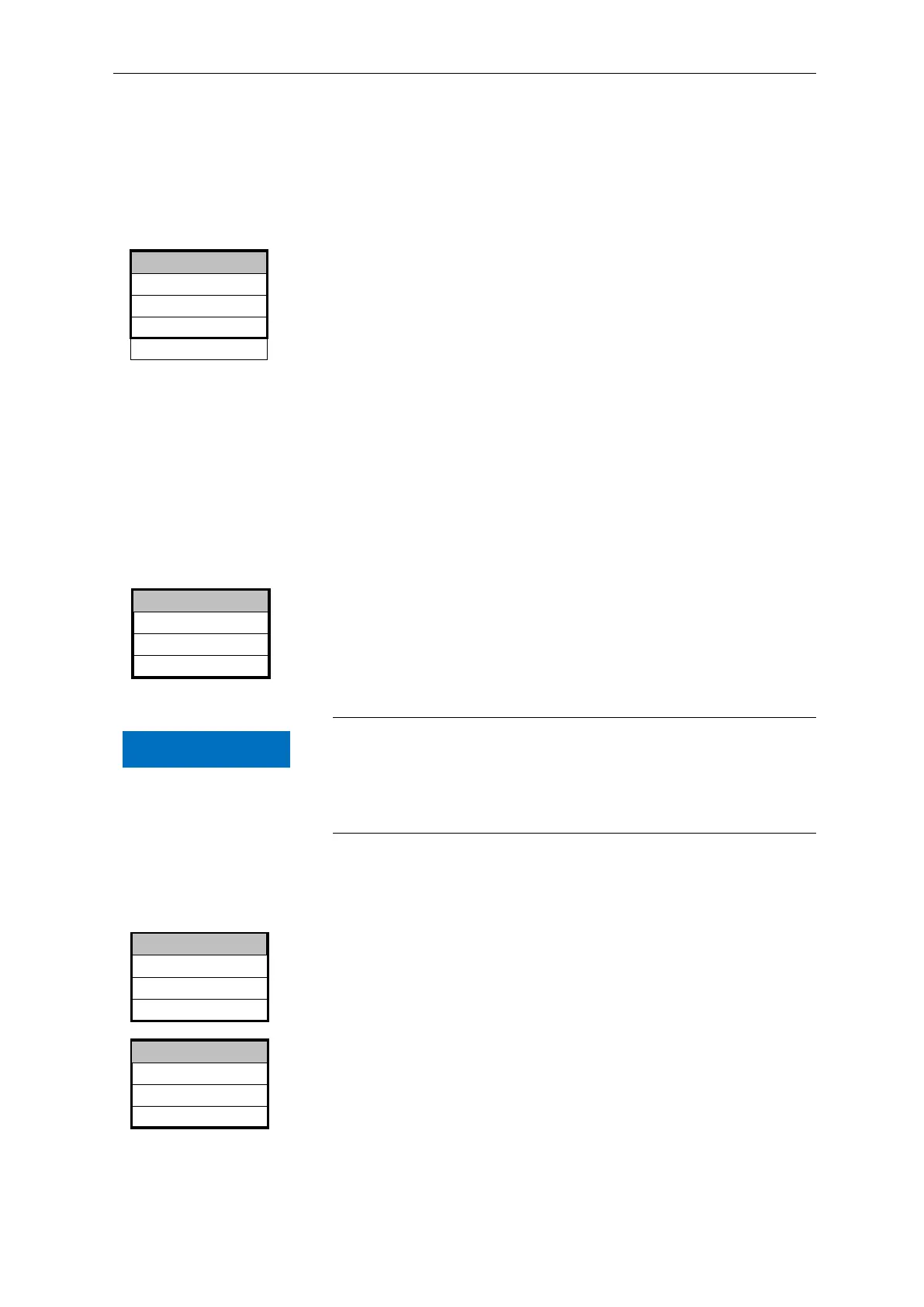
Contact „Suction“
Contact during analysis
Time: 00m:10s
CONTACT BEFORE ANALYS. *
>FUNCTION AUX ▼▲
ME
Reset
000023h
>OPERATING TIME ▼▲
ME
RESET OPERATING TIME
>SERVICE II ▼▲
ME
Maintenance interval
RESET OPERATING TIME
>SERVICE II ▼▲
ME
NOTE


 To Next Page