
 Need help?
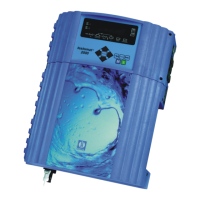
Do you have a question about the Heyl Testomat 2000 and is the answer not in the manual?
Outlines the product's purpose and required user expertise for safe operation.
Explains warning system structure and provides general operational guidelines.
Covers safety precautions for installation, operation, cleaning, de-installation, and disposal.
Details reagent consumption, water quality impact, interference factors, and handling advice.
Guidelines for choosing an installation site and adjusting the pressure range.
Details on connecting the water inlet and outlet, including operational tips.
Instructions for connecting power supply, devices, and notes on EMC.
Diagram illustrating the internal components of the Testomat 2000® Polymer.
Step-by-step guide for connecting the instrument to the mains voltage.
Instructions for connecting external plant components to the instrument's relays.
Details on connecting external signals to the instrument's inputs and outputs.
Procedures for safely handling reagents and inputting their levels.
Information on switching the device on/off and operating the water inlet.
Explains the meaning of various display elements and status indicators.
Identifies and explains the function of the device's operating keys.
Procedure for setting the instrument's date, time, and weekday.
Details on password entry for basic programming and selecting the operating mode.
Settings for flush times, analysis interval pause, and volume-based control.
Configuration for priority settings, external analysis start, and display units.
How to set and check the measurement factor for accurate readings.
Steps for configuring internal and external flushing parameters.
Configuration of analysis interval pauses and limit value monitoring.
Setting hysteresis and defining functions for limit value outputs LV1 and LV2.
Details on various switch functions, measuring point configuration, and IN1 input.
Configuration for water meter input and alarm/message signaling.
Configuration of the AUX relay output and functions within the Service II menu.
Guidelines for safe input connections and description of Start/Stop inputs.
Details on IN1, IN2, OUT terminals and optional interface cards.
How to monitor single and multiple measuring points with interface outputs.
Procedure for setting reading ranges and understanding output current calculations.
Details on RS232 interface, SD card logging, and external flush valve output.
Configuration options for LV1 and LV2 limit value relay outputs.
Details on limit value outputs and measuring point switch-over.
Programmable functions for the AUX relay output.
Description of the Alarm and Maintenance relay outputs and their functions.
How to access customer service, operating values, program values, error history, and maintenance data.
Navigation through Service I, reagent input, and manual operation functions.
Functions for confirming maintenance, diagnosing status, and setting time/date.
Troubleshooting steps for interface errors and general unit malfunctions.
Guidelines for required maintenance tasks and cleaning precautions.
Procedures for maintaining sight glass windows and cleaning the filter housing.
Service advice, pump head maintenance messages, and replacement procedures.
 General
| Protection Class | IP 65 |
|---|---|
| Type | Water hardness monitor |
| Measuring Range | 0.05 – 25 °dH |
| Power Supply | 230 VAC |
| Ambient Temperature | 10 to 40 °C |

 To Next Page