132 ES-50X Series Manual — P/N LS10129-000FL-E:E 5/23/2022
Power Supply Calculations Calculating the Battery Size
9.4 Calculating the Battery Size
Use Table 9.4 to calculate the total Standby and Alarm load in ampere hours (AH). This total load determines the battery size (in AH),
required to support the system upon loss of primary (AC) power. Complete Table 9.4 as follows:
1. Enter the totals from Table 9.3 on page 131, Calculation Columns 2 and 3 where shown
2. Enter the NFPA Standby and Alarm times (refer to ‘NFPA Requirements’ below)
3. Calculate the ampere hours for Standby and Alarm, then sum the Standby and Alarm ampere hours
4. Multiply the sum by the derating factor of 1.2 to calculate the proper battery size (in AH)
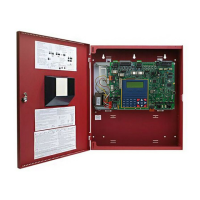
5. Write the ampere hour requirements on the Protected Premises label located inside the cabinet door
9.4.1 NFPA Battery Requirements
NFPA 72 Local, Proprietary, Central, Auxiliary and Remote Fire Alarm Systems require 24 hours of standby power followed by 5 min-
utes in alarm.
9.4.2 Selecting and Locating Batteries
Select sealed lead acid batteries that meet or exceed the total ampere hours calculated in Table 9.4 . The control panel can charge batter-
ies in the 7 AH to 18 AH range. The control panel cabinet is capable of housing batteries up to 18 AH. Batteries larger than 18 AH
require a UL listed external battery charger and cabinet such as the BB-26, BB-55F or other UL listed external battery cabinet.
1 Main board with display only.
2 If using the Reverse Polarity Alarm output, add 0.005 amps; if using the Reverse Polarity Trouble output, add another 0.005 amps.
3 Refer to the Device Compatibility Document for standby current.
4 Must use compatible listed Power Supervision Relay. Use the current values listed in the device documentation.
5 Maximum alarm current for each sounder base is 0.015 amps which must be supplied by aux. 24VDC source.
6 When powered by an external source, use 0.040A. When powered by the SLC, use 0.024A.
7 If using Gentex brand NACs, the max number of devices for each NAC output is 35. The “UL Max” current rating, published in their data sheets, must
be used in order to maintain performance under low battery conditions with the maximum wire resistances shown in Table D.2 on page 144.
8 Total Alarm current load cannot exceed 3.0 amps.
9 When AC power is initially applied to the panel and the battery is not fully charged, an initial charge current of up to 5.3 amps may be observed at the
battery. This high current is only applied for a very short duration (milliseconds) and does not affect system load or battery size calculations.
10 Total Standby current load cannot exceed 2.25 amps.
Total Standby Load, Battery Powered
(from Table 9.3 Calculation Column 3)
[ ]
Required Standby Time
(24 hours)
X[ ] = AH
Total Fire Alarm Load, Battery Powered
(from Table 9.3 Calculation Column 2)
[ ]
Required Alarm Time
(for 5 min., enter 0.084,
for 10 min., enter 0.168)
X[ ] = AH
Sum of Standby and Alarm Ampere Hours = AH
Multiply by the Derating Factor X 1.2
Battery Size, Total Ampere Hours Required = AH
Table 9.4 Total Secondary Power Requirements at 24 VDC



 To Next Page
 Loading...