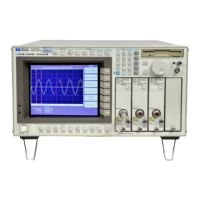
Model 141A
Section
Ill
Paragraphs 3-17 to 3-24
c. Use WRITING RATE inMAX onlyforfast sweep
time, single-shot displays,or to improve the uniform-
ity of trace intensity. TheMAXposition causes more
rapid positive fading on the CRT and persistence or
storage time of the display
is
thus reduced.
d. To store
a
display, set the PresentationSelector
to WRITE, adjust the INTENSITY and PERSISTENCE
for the desired display and rotate the Presentation
Selector to STORE.
e.
To view astoreddisplay, rotate the Presentation
Selector to VIEW, or set PERSISTENCE fully clock-
wise, INTENSITY to fully counterclockwise and rotate
Presentation Selector to WRITE.
f.
To store more than one display, set Presentation
Selector to WRITE, set PERSISTENCE fully clockwise
and INTENSITY
as
required; allow first display to be
written on the CRT. Set INTENSITY fully counter-
clockwise andconnect secondsignal to
be
stored. Re-
set vertical POSITION
if
second display
is
not to be
superimposed on first. Slowly rotate INTENSITY
clockwise until second display appears. Rotate Presen-
tation Selector to STORE andbothdisplays
are
stored.
g. A display, whichisstored when the Model 141A
power
is
turned off, will remain stored for several
da!*s. To redisplay the storedwaveforms, rotate the
Presentation Selector to VIEW and the vertical POSI-
TION control counterclockwise, before turning the
power on. This will prevent
a
bright spot caused by
the initial surge from the write gun.
h. To
erase
all persistent or stored displays, set
Presentation Selector to WRITE and rotate PERSIS-
TENCE control counterclockwise to (but not in)
NORMAL detent, or rotate Presentation Selector to
ERASE for approximately 2 seconds, then release.
(First method not effective when WRITING RATE
is
set to MAX.)
i.
With WRITING RATE in MAX, PERSISTENCE
counterclockwise but not inNORMAL detent, Presen-
tation Selector in WRITE and INTENSITY clockwise
just enough to make
a
display visible, the display may
possibly be stored. This type of operation may be
useful in comparing variations in
a
repetitive waveform.
To observe the multiple displays
so
stored, rotate the
Presentation Selector to VIEW.
j.
If only
a
portion of
a
slow sweep display
is
de-
sired, switch the Presentation Selector to STORE
when the trace has been written to the desired point;
the write gun
is
blanked and the written portion
is
stored.
k.
Use
a viewing hood,
if
desired, to improve
screen-display contrast.
m. Figures 3-2 through 3-9
are
provided to show
typical CRT displays with various control settings and
input
signals.
They areexamples which,
if
duplicated
by the operator, will aid in understanding the operation
of the Model 141A. Figure 3-9 shows small bright
spots on the CRT screen which
are
caused by minute
imperfections in the storage mesh.
3-23. SINGLE-SHOT OPERATION.
3-24. To write with persistence or store
a
single-shot
phenomena, trial setting of INTENSITY
is
the best
3
-3
i.
BACKGROUND ILLUMINATION
-
A green cloud
of illumination visible on the CRT screen, Figure 3-2.
j. SWEEP TIME
-
The time (in seconds, milli-
seconds, or microseconds) required for the beam to
move horizontally one unit of distance (centimeter)
across the CRT screen, when writing
a
display.
3-17. CONTROL FUNCTIONS.
3-18. PERSISTENCE and INTENSITY. These controls
contribute to the duration of afterglow of
a
display.
The PERSISTENCE control sets the rate at which
a
display
is
erased; INTENSITY sets the brightness of
the
trace
as
it
is
written.
WithagivenPERSISTENCE
setting, the actual duration of trace afterglow may be
inrreased by increasing the INTENSITY. Since the
PERSISTENCE control sets the rate of erasing a
written display, it follows that
a
brighter trace will
require more time
to
be erased. Conversely, a dis-
play of low intensity will disappear more rapidly. The
same principle applies to a stored display of high and
low intensity.
The storage mesh of the CRT
is
not easily damaged, however,
a
high-intensity repetitive trace or
spot,written on the screen for an
extended time, may not erase
completely.
To
prevent CRTdam-
age, use minimum INTENSITY
which will give the desired display
for
a
given PERSISTENCE setting.
3-19. PRESENTATION SELECTOR. This control
selects the mode in which the CRT functions. In the
ERASE position, the other three functions are dis-
connected and all stored and persisting displays are
removed from the CRT. The WRITE position
is
the
only position on the selector in which a display may be
written on the CRT screen. TheSTOREposition dis-
connects the WRITE function and retains written dis-
plays (at reduced intensity) on the CRT. INTENSITY
and PERSISTENCE do not function in the STOREposi-
tion. The VIEW position intensifies the stored display
to set a brightness and again, INTENSITY and PER-
SISTENCE do not affect the display.
3-20. WRITING RATE. In the MAX position, the rate
of erasing a written display
is
decreased. Since the
erasing rate
is
decreased, the entire screen becomes
illuminated more rapidly and the display
is
obscured.
The effective persistence and storage time
are
thus
considerably reduced.
3-21. OPERATING TIPS.
3-22. This information
is
provided to aid the operator
in becoming familiar with the Model 141A controls and
their functions, and to serve as
a
guide for obtaining
the desired CRT display.
set
WRITING RATE and PERSISTENCE to NORMAL, Func-
tion Selector to WRITE and use minimum INTENSITY.
b. For variable persistence operation, use mini-
mum INTENSITY and maximum PERSISTENCE com-
patible with the desired display.
(See
Figure 3-3.
)
a. For conventional Oscilloscope operation,
02567-1


 To Next Page