25
PART 6 – ELECTRICAL CONNECTIONS
A. LINE VOLTAGE INPUT
The heater must be wired to a 120 volt circuit by a qualified electrician. It is recommended that the heater
be wired on its own circuit to minimize the possibility of circuit failure due to outside causes. The heater
requires a maximum of 8 amps at 120 volts in use.
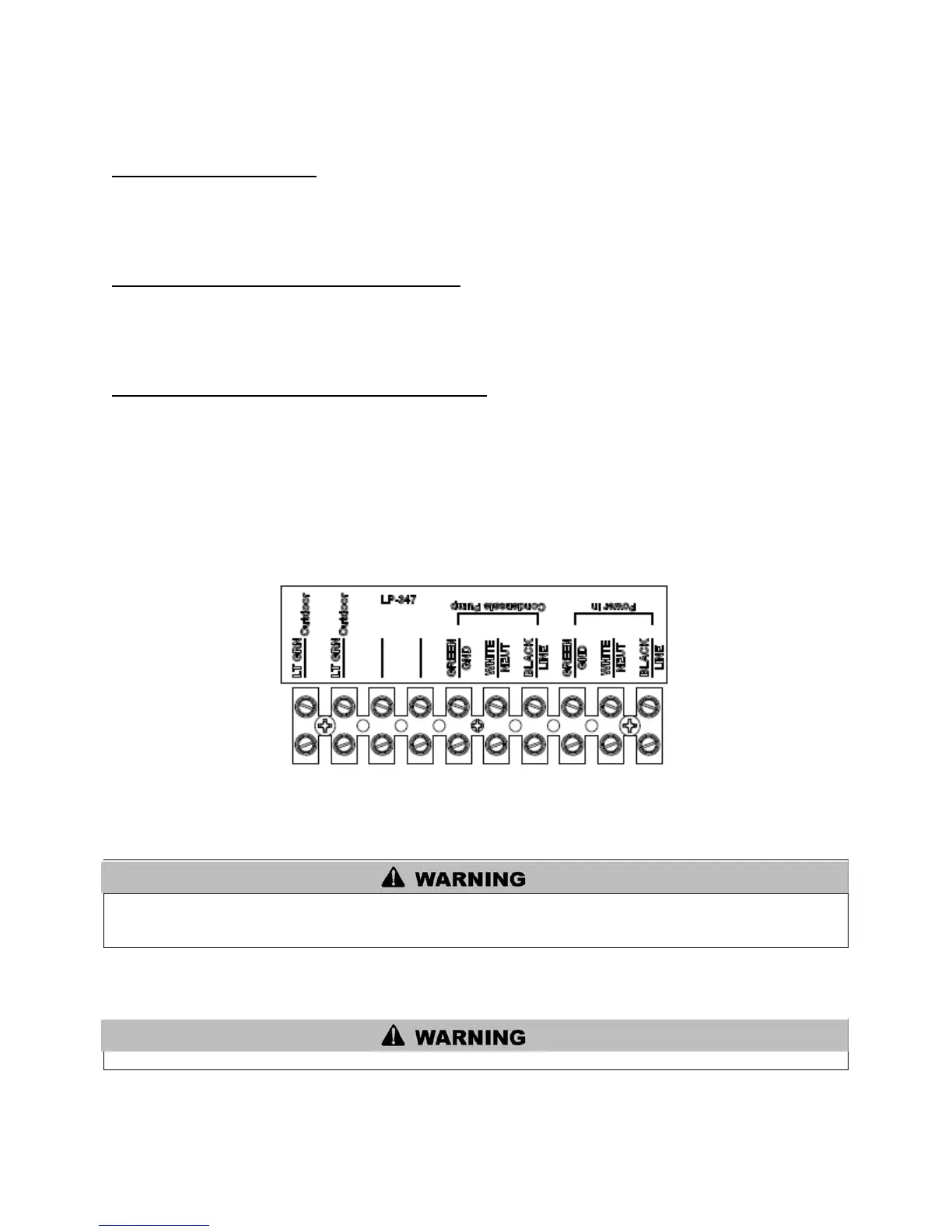
B. LINE VOLTAGE CONDENSATE OUTPUT
The heater has the capability of supplying power to a condensate pump. The connection is 120 VAC +/-
10% at a max of 2 amps. Power is supplied to the pump only when the heater is connected to power, and
the power switch is in the on position.
C. LOW VOLTAGE OUTDOOR SENSOR INPUT
The heater has the capability of an outdoor reset. Connecting an outdoor sensor allows the heater to
operate at optimum efficiency. HTP offers an outdoor sensor, p/n 7250P-319
The outdoor sensor must be a 12K NTC sensor. Use a minimum 22 AWG wire for runs of 100 feet or less
and minimum 18 AWG wire for runs up to 150 feet. Instructions are included with the outdoor sensor to
correctly mount the sensor on the exterior surface of the building. It is preferable to mount the sensor on
the north side in an area that will not be affected by direct sunlight but will be exposed to varying weather
conditions. Connect the outdoor sensor to terminals marked “Outdoor”.
Figure 11 – LP-179-Y
PART 7 – GAS CONNECTIONS
Failure to follow all precautions could result in fire, explosion, severe injury or death!
It is of extreme importance that this unit be properly grounded. It is very important that the building system
ground is inspected by a qualified electrician prior to making this connection. Electrical power must only
be turned on when the heater is completely filled with cold water.





 To Next Page