HUAWEI SE2900 Session Border Controller
Hardware Description
1 Service Processing Device
Huawei Proprietary and Confidential
Copyright © Huawei Technologies Co., Ltd.
1.9.2 VPUA1
Functions
Table 1-52 describes the functions of the VPUA1.
Table 1-52 Functions
Uses one Intel
®
Xeon
®
full-power, 6-core Ivy Bridge-EN CPU.
Provides two double data rate 3 (DDR3) memory channels, each for
installing one 16 GB registered dual in-line memory module
(RDIMM). The board offers The maximum memory capacity is 32
GB.
Supports 800 MHz, 1066 MHz, and 1333 MHz RDIMMs.
Supports error checking and correction (ECC).
Provides two 1GE Base ports for communicating with Base planes of
multi-function switch units (MXUs) through the backplane.
Provides two 20GE Fabric ports for communicating with Fabric
planes of MXUs through the backplane.
Provides two 10GE enhanced small form-factor pluggable (SFP+)
optical ports and two GE SFP optical or electrical ports. These four
ports are reserved.
Provides an independently powered baseboard management controller
(BMC). The BMC connects to the SMM through the Network Controller
Sideband Interface (NC-SI) bus. The BMC provides the following
functions:
Manages the field replaceable unit (FRU) information, sensor data
records (SDRs), and system event logs (SELs).
Detects the board temperature and voltage, reports alarms, and
controls the power-on, power-off, hot swap, and reset operations of
the board.
Supports serial port redirection.
Loads board software online.
Provides a loading interface for board testing.
The boards are hot-swappable.
Appearance
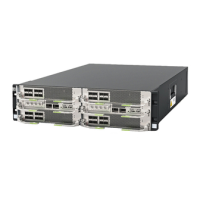
The VPUA1s are half-width boards and installed in the front service board slots of the
subrack. Figure 1-58 shows a VPUA1 board.


 To Next Page