50
Monitoring Maternal Parameters
7.4 Maternal ECG
Monitoring MECG allows a check to be made that the fetal heart rate being
recorded does in fact belong to the fetus and not the mother.
MECG monitoring procedure
1. Use self-adhesive disposable electrodes. Placement of the electrodes is not
critical, though it is a good idea to have the lower electrode placed clear of
the diaphragm, as the muscles here are very active in contraction.
A recommended arrangement might be:
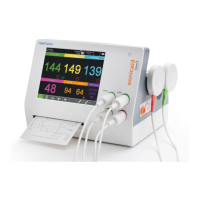
2. Connect the MECG lead (white) to the MECG socket on the side of Team 3.
3. Clip the three fl ying leads of the MECG lead to the electrodes. They are
colour-coded white, black and red (W, B and R in the diagram above).
4. Allow a few minutes for the signal to stabilise and a clear maternal heart
rate to be displayed. Check the signal visually by displaying the MECG
waveform (Press
> ).
If the maternal and/or fetal heart rates appear similar an alarm will sound and
'FETAL CROSS CHANNEL' will be printed.
Confi rm the source of the fetal heart being monitored.
A poor MECG signal will prevent the FHR cross-checking from
functioning. If a good MECG signal cannot be obtained, other
methods must be used to ensure FHR integrity so as to prevent
accidental interpretation of MHR as FHR.
Check MECG signal quality regularly to ensure that no
deterioration has occurred.
The Team 3I MECG function is not intended for diagnostic use
- where maternal cardiac monitoring is required appropriate
diagnostic patient monitoring equipment must be used.


 To Next Page
 Loading...