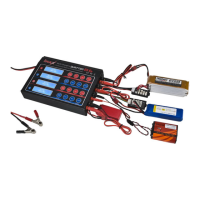
To avoid short-circuits between the charge lead, always connect the charge cable to the
unit first and only then to the batter to be charged or discharged. Reverse the sequence
when disconnecting.
Very Important!
Do not connect more than one battery pack to the charge lead at any one time.
The charger is not suitable for the following battery types
Battery pack, which consists of different types of cell (including different manufactures)
Battery which is already fully charged or just slightly discharged
Non-rechargeable batteries (Explosion hazard).
Batteries that require a different charge technique from NiCd, NiMH, Lilo, LiPo, LiFe or
Pb.
Faulty or damaged battery
Battery fitted with an integral charge circuit or a protection circuit.
Batteries installed in a device, or which are electrically linked to other components.
Batteries that are not expressly stated by the manufacture to be suitable for the
currents the charger delivers during the charge process.
Please bear in mind of checking the following point before
charge operation:
Did you select the appropriate program, which are suitable for the type of battery?
Did you set up adequate current for charging or discharging?
Lithium battery pack can be composed with parallel and series circuits mixed. You have
to check the composition of the battery pack carefully before charging
Are all connections firm and safe, or is there an intermittent contact at any point in the
circuit?
Charging
A specific quantity of electrical energy is fed into the battery during charge process.
The charge quantity is calculated by multiplying charge current by charge time. The
maximum permissible charge current varies according to the battery types or its
performance, and can be found in the information provided by the battery manufacture.
It is only allowed to charge batteries at rates higher then the standard charge current if
they are expressly stated to be capable of quick-charge.
Connect the battery to charge to output terminal of the charger using suitable charge
05


 To Next Page