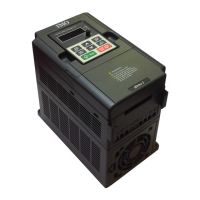
9-3 Specifications
9
Item Detail specifications
Maximum 50 to 400 Hz variable
frequency
Base 25 to 400 Hz variable
frequency
Starting
frequency 0.1 to 60.0 Hz variable, Holding time : 0.0 to 10.0s.
Carrier 0.75 to 15 kHz (The carrier frequency may automatically drop to 0.75 kHz to
frequency protect the inverter. )
Accuracy Analog setting: Within ± 0.2 % (25 ± 10 °C)
Digital setting: Within 0.01% (-10 to +50 °C)
Setting
resolution Analog setting: 1/3000 of maximum output frequency
Keypad panel setting: 0.01 Hz (99.99 Hz or lower), 0.1 Hz (100.0 to 400.0 Hz)
Link setting : «1/20000 of Maximum frequency
(0.003Hz at 60Hz,0.006Hz at 120Hz,0.02Hz at 400Hz)
or 0.01Hz (Fixed)
Voltage/freq. Adjustable at base and maximum frequency,
Characteristics with AVR control : 80 to 240 V(200V class),160 to 480V(400V class)
Torque boost Automatic:Automatic torque boost can be selected with code setting.
Manual: Setting by codes 1 to 31 (Boost for Variable torque available)
Starting torque Starting torque 200% or above
(with dynamic torque vector turned on, during 0.5 Hz operation)
DC braking Braking time (0.0 to 30.0 s), braking current (0 to 100%), braking starting
frequency (0.0 to 60.0 Hz) variable
Control method Sinusoidal PWM (Dynamic torque vector control) with "current vibration
suppression function" and "dead time compensation function"
Operation method Keypad operation: starting and stopping with and keys.
(Keypad panel)
Digital input signal: forward (reverse) operation, stop command (3-wire operation
possible), coast-to-stop command, external alarm, error
reset, etc.
Link operation: RS485 (Standard)
Profibus-DP,Interbus-S,DeviceNet,Modbus Plus,
CAN open (Option)
9-2 Common Specifications
Output frequency
Adjustment
Control
RUN
STOP



 To Next Page