STARTING AND OPERATING 121
2-SPEED FOUR-WHEEL DRIVE
(4WD) — I
F EQUIPPED
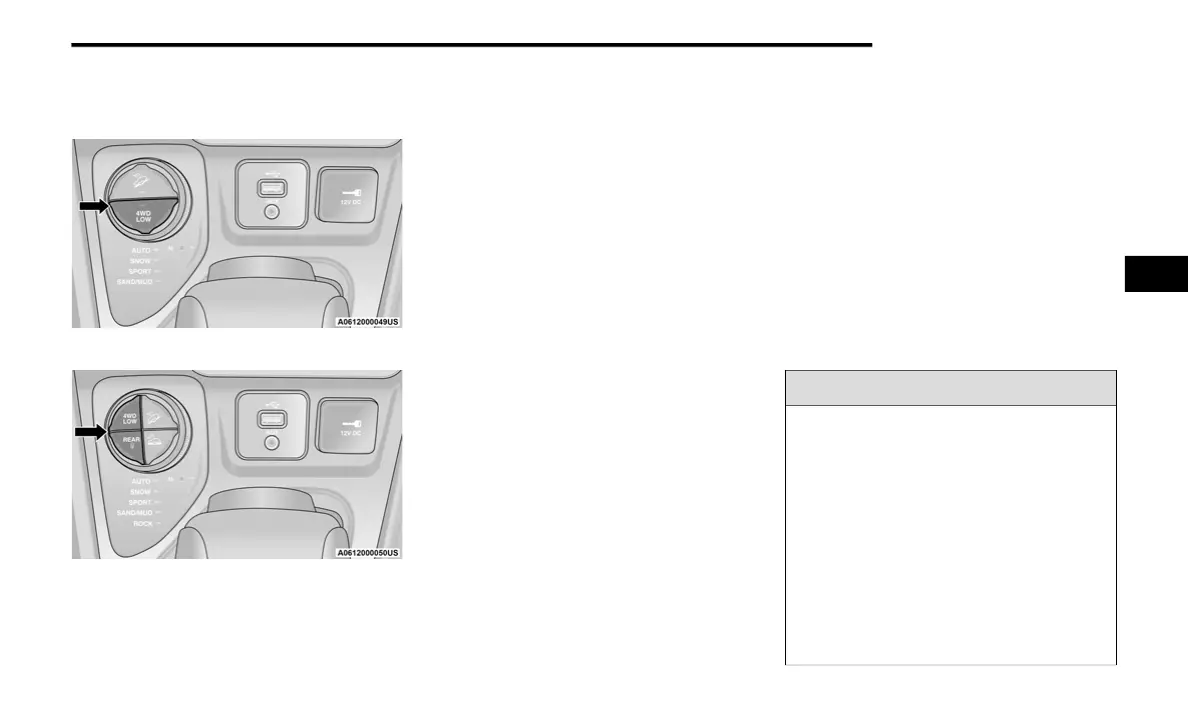
2-Speed 4x4 Switch
2-Speed 4x4 Switch (with Rear Lock)
The Four-Wheel Drive is fully automatic in the
normal driving mode. The Selec-Terrain buttons
provide three selectable mode positions:
4WD LOW
REAR LOCK (If Equipped)
NEUTRAL
When additional traction is required, the 4WD
LOW range position can be used to provide an
additional gear reduction, which allows for
increased torque to be delivered to both the
front and rear wheels. 4WD LOW is intended for
loose, slippery road surfaces only. Driving in
4WD LOW on dry, hard-surfaced roads may
cause increased tire wear and damage to
driveline components.
When operating your vehicle in 4WD LOW, the
engine speed is approximately three times that
of the normal driving mode at a given road
speed. Take care not to overspeed the engine,
and do not exceed 25 mph (40 km/h).
Proper operation of four-wheel drive vehicles
depends on tires of equal size, type, and
circumference on each wheel. Any difference
will adversely affect shifting and cause damage
to the driveline components.
Because four-wheel drive provides improved
traction, there is a tendency to exceed safe
turning and stopping speeds. Do not go faster
than road conditions permit.
SHIFT POSITIONS
For additional information on the appropriate
use of each 4WD system mode position, see the
information below:
NEUTRAL
This range disengages the driveline from the
powertrain. It is to be used for flat towing behind
another vehicle Ú page 172.
WARNING!
You or others could be injured or killed if you
leave the vehicle unattended with the power
transfer unit in the NEUTRAL (N) position
without first fully engaging the parking brake.
The NEUTRAL (N) position disengages both the
front and rear driveshafts from the powertrain
and will allow the vehicle to roll, even if the
transmission is in PARK. The parking brake
should always be applied when the driver is not
in the vehicle, unless the vehicle is otherwise
secured (for example, when attached to the
tow vehicle).
4
21_KL_OM_EN_USC_t.book Page 121












 To Next Page