TECHNICAL SPECIFICATIONS 413
2.0L ENGINE
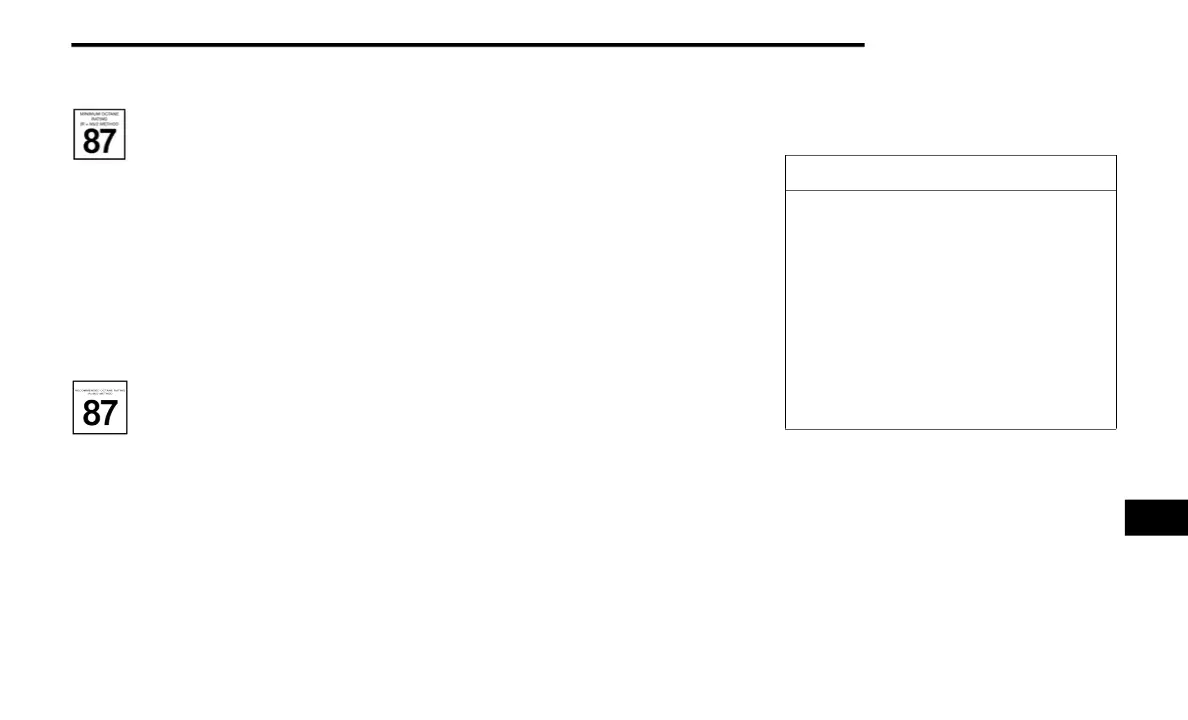
This engine is designed to meet all
emission requirements, and provide
satisfactory fuel economy and
performance, when using unleaded
“regular” gasoline having an octane rating of
87, as specified by the (R+M)/2 method. The
use of 91 or higher octane “premium” gasoline
will allow these engines to operate to optimal
performance. This increase in performance is
most noticeable in hot weather or other heavier
load conditions, such as while towing.
2.4L AND 3.2L ENGINES
These engines are designed to meet
all emissions regulations and provide
optimum fuel economy and
performance when using unleaded
“Regular” gasoline having a posted octane
number of 87 as specified by the (R+M)/
2 method. The use of higher octane “Premium”
gasoline is not required, as it will not provide
any benefit over “Regular” gasoline in these
engines.
REFORMULATED GASOLINE
Many areas of the country require the use of
cleaner burning gasoline referred to as
“reformulated gasoline”. Reformulated
gasoline contains oxygenates and are
specifically blended to reduce vehicle
emissions and improve air quality.
The use of reformulated gasoline is
recommended. Properly blended reformulated
gasoline will provide improved performance
and durability of engine and fuel system
components.
GASOLINE/OXYGENATE BLENDS
Some fuel suppliers blend unleaded gasoline
with oxygenates such as ethanol.
Problems that result from using gasoline
containing more than 15% ethanol (E-15) or
gasoline containing methanol are not the
responsibility of the manufacturer and may void
the New Vehicle Limited Warranty.
CAUTION!
DO NOT use E-85, gasoline containing
methanol, or gasoline containing more than
15% ethanol (E-15). Use of these blends may
result in starting and drivability problems,
damage critical fuel system components,
cause emissions to exceed the applicable
standard, and/or cause the Malfunction
Indicator Light to illuminate. Please observe
pump labels as they should clearly
communicate if a fuel contains greater
than 15% ethanol (E-15).
9
21_KL_OM_EN_USC_t.book Page 413














 To Next Page